
Third Sunday in Ordinary Time – Sunday of the ‘Word of God’.
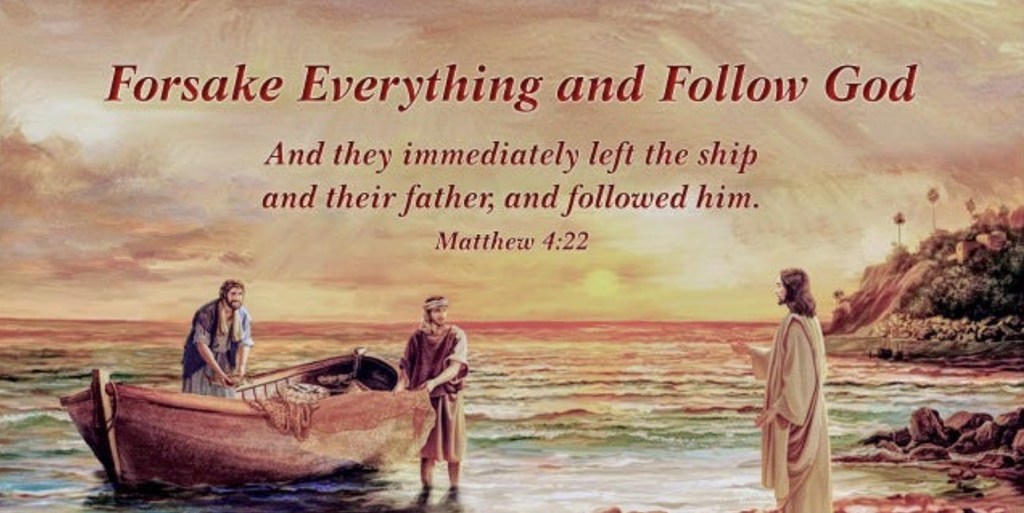
“Follow me and I will make you fishers of men.” Today we hear how Jesus moves to his new home at Capernaum, a thriving busy fishing town on the northwest shore of the Sea of Galilee. This became a good base for Jesus starting his ministry. Then he builds up a group of disciples, starting with four men, Peter and Andrew, then later James and John. Remarkably without deliberation or hesitation they dropped everything and followed him. I wished it was all that easy for me when I first heard my calling for the Priesthood. I had so many barriers to overcome, with mountains of problems to deal with that I felt I couldn’t cope. So, here is a little of my vocational story.
It was around 2008 when I started thinking more deeply about my life’s direction. My occupation at that time was working at Preston Hospital in the Computer department, fixing and maintaining their computer systems. But I felt something was missing, I wasn’t being fulfilled in my work any longer, I was longing to help in God’s mission of spreading the Good News, but unsure exactly how to do it.
I was a regular church goer every Sunday’s, but all of a sudden, I felt one hour per week didn’t feel adequate to me anymore. So, I made the effort to go more regularly. The more I prayed, especially in front of the Blessed Sacrament during Holy Hour, the more Jesus was speaking to me, and I was being pulled towards the idea of the Priesthood.
It wasn’t until the Late Pope Emeritus Benedict XVI visit to the UK in 2010 for the beatification of Cardinal John Henry Newman when I decided that enough time had been spent thinking about the Priesthood, and I needed to start getting the ball rolling. So, I contacted the vocations director and started my many monthly meetings.
My discernment process didn’t go smoothly, I was rejected twice at the interview stages, that made me depressed. But with perseverance, over the next few years, I was given a twelve month placement opportunity within the diocese.
Finally, I was accepted by the Bishop, to study at St. Mary’s College, Oscott in Birmingham for my Seminary training. It was a six-year course, studying for a double degree in Theology. As you can imagine living at Seminary is not the easiest thing to do. Living with 60 other seminaries, day in, day out, you really looked forward to your day off. Like most communities there were arguments and disagreements that had to be worked through. But you keep saying to yourself, its not a monastery you’re not here forever.
It was important not to dwell too much on work or exams, even though at times, it was very stressful. What was key is my relationship with the Lord, keeping up my prayer life, being open to change, which would mould me into a better person, allowing me to become a good priest for the future.
As you can imagine there were many dropouts at college, people you didn’t expect, thinking that they would become great priests. But through the grace of God, I made it to Priestly Ordination. It was all worthwhile, but it was a long and challenging time of training and discernment. The Lord must have thought I needed it.
So, today, as we celebrate ‘Sunday of the Word of God’ may we too be open to God’s Word, God’s call in our lives, whatever it may be. Either at home, or at work, helping with Church duties, or joining Church groups.
Give yourself time to listen to His voice in the silence of your hearts. You maybe being prompted to help as a Reader or an Altar server. Or maybe the religious life of being a Sister, Deacon or Priest. Whatever it may be, take that step, full of confidence, and the Lord will reward you with so many blessings for your faith, love and charity.
The Lord calls everybody in some shape or form. May we too become ‘fishers of men’ ready to drop everything at His ‘Word’ to build up the Kingdom of Heaven, and to change the world.


 Rev. Fr Philip Wrigley's Blog