
Fifth Sunday of Easter
In our first reading we hear the end of the first Mission of the disciples. St Luke provides us with a glimpse into the missionary method of Paul and Barnabas. We might wonder how Paul can return to the same cities from which he has just been expelled or fled from, in fear for his life. One reason is that, Paul and Barnabas were persecuted for publicly preaching to unbelievers, but now they are ministering privately to the new Church of Christians. Without these follow up visits, the new converts could easily return back to their previous beliefs or patterns of misconduct. They are in need to be reinforced in their new faith, having extensive instruction, and encouragement, to remain constant in the difficulties they will expect to face.
Paul and Barnabas repeat the sober warnings that Jesus had given to his followers, that by following him, is a narrow and difficult path. This means, suffering and hardship. The risen Christ teaches: ‘Was it not necessary of salvation, that the Messiah should suffer these things, and enter into his glory?’ Now providing local leadership, the apostles Paul and Barnabas give guidance to the new churches. They provide Bishops and Priests, probably from the group of Jewish believers, whose knowledge of Scripture and biblical morality would have been more advanced. However, it is still through the Holy Spirit that guidance was given in commissioning these men who were chosen.
They commended these new leaders to the Lord, since the successful ministry of the Church ultimately depends on the risen Christ Jesus himself.
In the Gospel with the departure of Judas, the events leading to Jesus hour on the cross has begun. The focus now shifts to Jesus and his faithful disciples, with the final Farewell discourse.
The cross is Jesus’ moment of glorification because in the cross God is revealing his self-giving love. The Father loves the Son, and gives him for the salvation of the world, and the Son in turn makes his life a perfect gift of love and obedience to the Father. The love between the Father and the Son is revealed on the cross, and through the wondrous event of the Resurrection, Jesus shows his marvellous divinity to the whole world.
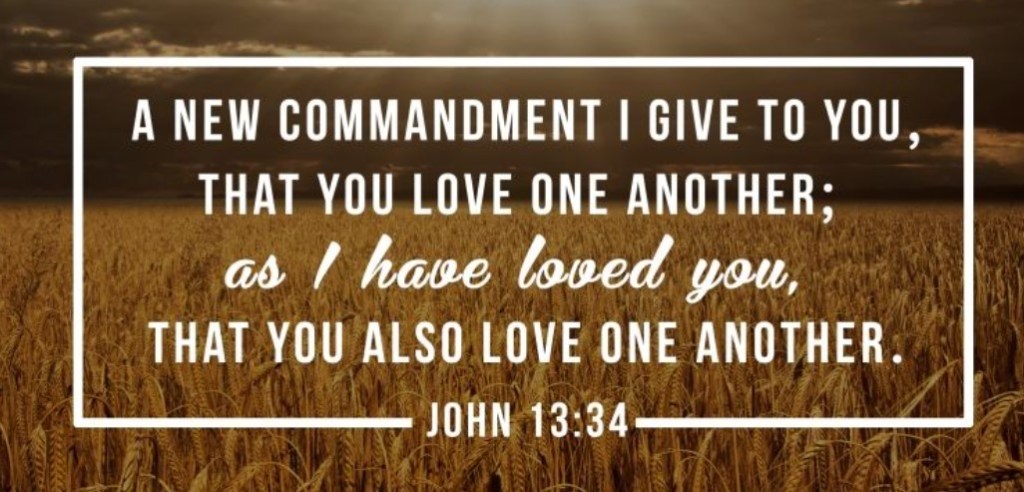
Jesus gives his disciples a new commandment, to love one another. Jesus’ love is the gift of himself, which symbolically was shown in the foot washing with his disciples. The disciples love for one another, will make known to all the people, that they belong to the Lord. The Catechism (CCC 2842) teaches us that: ‘there has to be a vital participation, coming from the depths of our heart, in the holiness, the mercy, and the love of our God.’ Through our loving actions, we become a living testimony and witness to the Father’s love, that was revealed on the cross.
Love finds its source in God, and this new Commandment in which we are called – to base our every action upon, is the root and very core of the Gospel message.
Love has the power to give meaning to the impossible situations in life, to bring light into darkness, to inspire people, fill them with hope and give them the courage to continue on the road ahead. The Good News we have chosen, are instruments of Jesus’ grace in our lives. A smile, a hug, a handshake costs nothing, but means so much, because it comes from the heart. When we fail as a Christian, it is probably down to the failure to love, that we haven’t given in that moment of time.
We are invited and encouraged to look into our hearts today, and see how we are answering God’s call to love, within our families, friends or in the workplace. The real test of love is how we respect others including our enemies. No one can be a friend of Jesus who does not love his neighbour as himself. Let us ask the Lord today for the grace to have our hearts opened, filled with God’s divine love, with the inspiration and wisdom of all the Saints, to share fruit abundantly, fruit that will last, with all of humanity.
 Rev. Fr Philip Wrigley's Blog