
Third Sunday of Lent – Year A
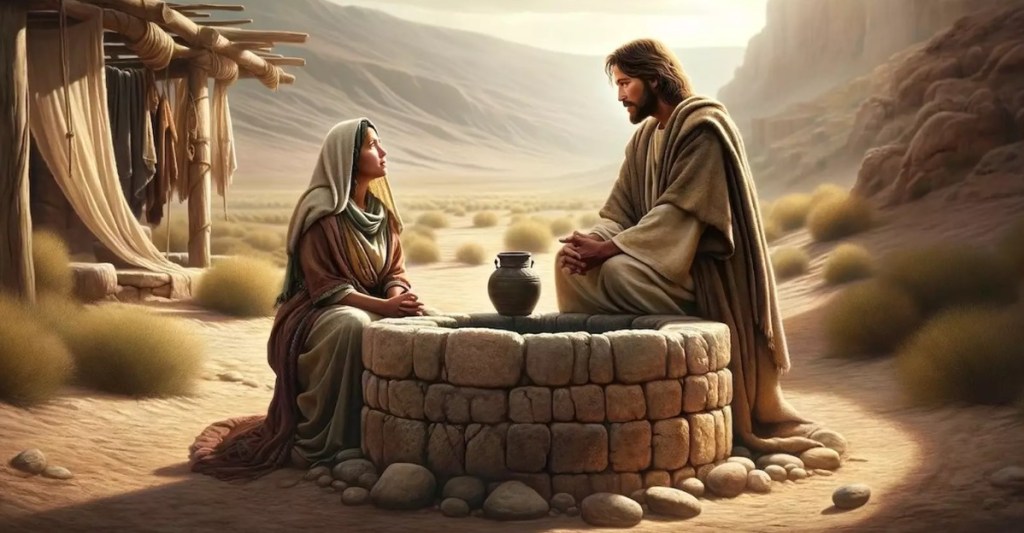
Today a very human picture is painted of the encounter between Jesus and the Samaritan Women at the well. Jesus who was exhausted from his long walk in the heat of the sun, sat wearily down and asked a woman for a drink of water. By doing so, he dismissed a century’s old Jewish tradition. Since Jews did not talk to Samaritan’s because of an old feud during the time when Israel was divided into the Northern and Southern Kingdoms.
Jesus begins the conversation with what seems like weakness: “Give me a drink.” God comes to us as one who thirsts. This is not only physical thirst; it symbolises His longing for us. St. Augustine famously said, “God thirsts, to be thirsted for.” In Jesus, God reveals that He desires a relationship with us more deeply than we often desire Him. He takes the first step, initiating conversation, breaking boundaries, crossing lines that humans have drawn.
The woman taking Jesus literally, and was astonished to hear that he could provide her with water that would last forever. As the conversation deepens the woman came to realise that her problem was not the lack of water, but an inner thirst that no earthly water could satisfy. A thirst that was caused by the absence of God in her life. Jesus led her to look deeply into her troubled life and helped unburdened her soul. Jesus accepted her as she came to terms with everything she ever did wrong, and was released from her guilt. Jesus gave her hope and offered her nothing less than the living waters of friendship and the Holy Spirit of God which leads to eternal life.
It took five husbands to teach the Samaritan Woman from her mistakes. Jesus’ conversation gives her great hope, because a worthwhile life seemed to be beyond her. However, Jesus won her over by gently leading her out of herself and raising her mind and heart to higher things. This conversation at the well restored this woman’s dignity and changed her life.
Notice what happens next. She leaves her water jar behind. The very symbol of her old routine, her old thirsts, her old patterns, she abandons it. When Christ truly enters a life, something must be left behind. Conversion means letting go not only of sin, but of the illusions we cling to, those false wells from which we keep drawing.
Then something remarkable happens: she becomes an evangelist. The woman who came alone, avoiding others, now runs to the town to tell them about Jesus. Grace does not merely soothe wounds; it sends us out.
She becomes a witness not because she has all the answers, but because she has encountered the One who knows her completely and loves her still.
Many believed in Jesus because of her testimony. The one who felt least worthy, becomes the means by which others meet the Saviour. That is the pattern of the Gospel. God chooses the unlikely. He works through the broken. He builds His kingdom with people who know their thirst and have discovered where the true water is found.
The people eventually say, “We no longer believe because of your word; we have heard for ourselves.” Evangelisation always leads to this. Our task is not to convert others ourselves, but to lead them to the One who speaks to their hearts more deeply than we ever could.
The Lord sits today beside the well of our own lives. He meets us in our routines, our hidden wounds, our unspoken loneliness. He comes not to judge but to draw out our thirst so that He may fill it.
Let us bring to Him the jars we carry, our burdens, our disappointments, our sins, our desires, and let us ask Him for the living water only He can give.
May we, like the Samaritan woman, allow ourselves to be known, to be healed, and to be sent. And may we discover in Jesus the One who satisfies every thirst.
 Rev. Fr Philip Wrigley's Blog