

The Assumption of the Blessed Virgin Mary
“Mary set out and went as quickly as she could to a town in the hill country of Judah.” The village of Ain Karim in the hill country near Jerusalem is the traditional site of the house of Zechariah and Elizabeth. It is located about five miles from the temple, convenient for Zechariah’s priestly duties. For Mary, however, the journey from Nazareth would be about 90 miles, depending on the route, and it would have taken several days. There is no mention of Joseph accompanying her, but it is nice to think that Joseph might have been with her, to help Mary along through dangerous and uncertain paths.
The Angel Gabriel said at the Annunciation: ‘Hail Mary, Full of Grace.’ The Catechism confirms that Mary did not suffer from Original Sin, which was the first sin of Adam and Eve eating of the forbidden fruit. Allowing Mary to receive the honour of being called ‘Immaculate’, Full of Grace.
This doctrine of the ‘Immaculate Conception’ shows God’s Divine power working by grace throughout Mary’s life, it can be traced all the way back to the beginning of her existence. The Immaculate Conception is the moment when Mary gave her ‘Yes’ to God, and God became Man, in Mary’s womb.
It is only fitting that the baby Jesus dwelt in a worthy place, a new Ark, a holy temple, a dwelling place fit for the Messiah, and not stained by sin.
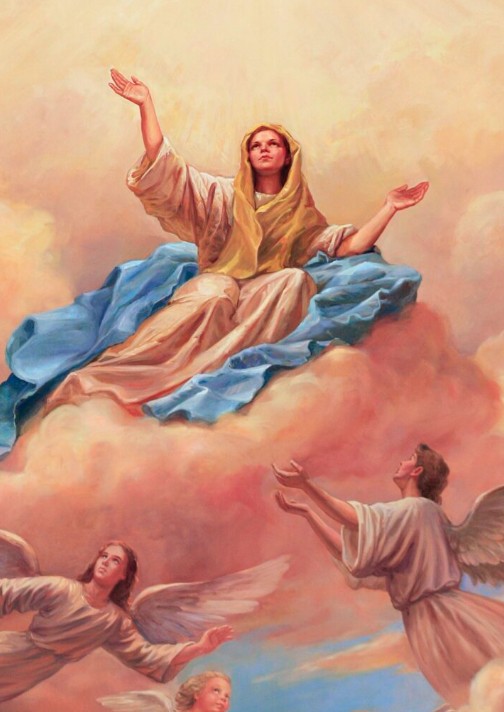
When Mary’s earthly life was finished, she was taken body and soul into Heavenly Glory. Since Mary was ‘Full of Grace, and did not suffer from original sin, it was fitting that Mary, like her Son, would not experience any bodily corruption.
We read in the Old Testament that Enoch was taken into Heaven without seeing death, in the book of Hebrews. Also, Elijah who was whisked into Heaven by the ‘Chariots of Fire’ in the whirlwind at the end of his life, from the second book of Kings. If God could assume these righteous men, it is certainly possible that Jesus could assume his own Mother as well.
The idea of Mary’s bodily Assumption into Heaven at the end of her earthly life, became a focus for early Marian devotions, with the first evidence for the celebrating of the ‘Feast of the Dormition’ dating back to the year 600 in Constantinople and then 50 years later in Rome.
There have been many legends about the death of Mary, her falling asleep and passing into Heaven. The oldest Greek narrative is from the Discourse of St John the Theologian, about the Falling asleep of the Mother of God. In his discourse, there is the well-known motif of the gathering of the apostles in Jerusalem, some of whom had died, and God granted them to be present at the bedside of Mary. Paul, Mark and James were included along with 12 other members during Mary’s final moments.
So, let us today, allow this Solemnity to give us the opportunity to reflect on Mary’s purity. She was the greatest background figure in the life of Christ, always co-operating with her Son. She lived as an example to imitate, living through the same ups and downs that we do every day.
On this joyful occasion, let us remind ourselves that our bodies are temples of the Holy Spirit, and like Mary, we are destined for that Glory that is presented to us, within the paradise of Heaven.
Let us allow Mary’s intercession to work in us and through us, as we become closer to the Lord, in mind, body and soul.
Our Lady, Mary Immaculate: Pray for us.

