

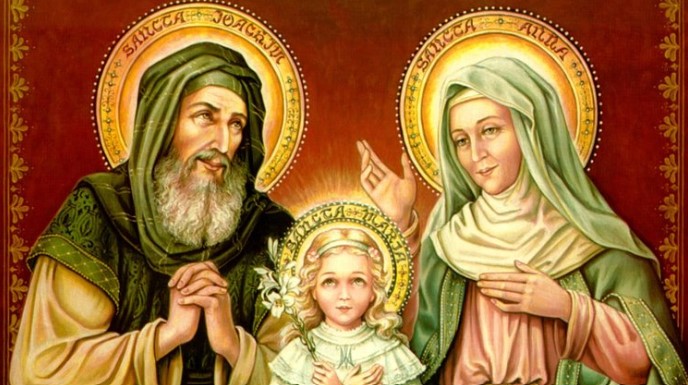
Below is my homily for todays memorial.
Today is the memorial of St. Joachim and St. Anne, the parents of Mary, and the Grandparents of Jesus. There is very little known about them, we receive their names in the gnostic gospel of St. James. Stories about Mary’s parents came to us mainly through legend and tradition.
We are told they were childless and sterile into old age, and after Joachim’s fasting and prayer in the desert and Anne weeping in lamentation for many years, an angel appeared to tell Anne and Joachim that they would have a child. Anne promised to dedicate this child to God. They were told by the angel the reason why it has taken so long. It was to increase their longing, to increase their awareness that every child comes from God.
The conception in Anne’s womb was unlike any other in human history, because her long awaited daughter was conceived without any stain of original sin, she was immaculate.
Mary was given Prevenient grace, which is a grace given by God before she was conceived. In the same way as God had always thought from the beginning of time, to send his Son Jesus to the world. It was also his thought to make Mary spotless, and full of grace so she could conceive Jesus as her Son.
Mary is full of Grace because of the divine task she had willingly accepted. She needed the full amount of grace to fulfil her role as God’s Mother.
St Joachim and St Anne knew that Mary was conceived miraculously in their old age, as a result of many prayers, but they had no idea of what God had planned for Mary.
It was the parents of Mary who nurtured her, taught her, and brought her up to be a worthy ‘Mother of God’. It was their teaching that led her to respond to God’s request with faith. “Let it be done to me as your will”. It was their example of parenting that Mary must have followed as she brought up her own son, Jesus. It was their faith that laid the foundation of courage and strength that allowed her to stand by the cross as her son was crucified and allowed her to still believe in God’s plan.
Such parents can be examples and models for all parents and grandparents today.
St John Paul II, Pope Benedict XVI and also Pope Francis have all stressed how important it is for grandparents and great grandparents to be the transmitters of wisdom to the younger generation. How important it is for the younger generation to ask them for wisdom, which they have gained through years of experience and lifelong reflection and prayerful examination on the Word of God. Let us have the inspiration to pass on our faith for the sake of the younger generation, so they may receive the wisdom and knowledge we have received through our years of prayer and close relationship with the Lord. “We are the virtuous that will shine like the Sun in the Kingdom of our Father in Heaven.”



 Rev. Fr Philip Wrigley's Blog