Homily – Luke 16:1-13

You cannot be the slave both of God and money.”  In this passage Jesus highlights the importance of being ‘trustworthy & faithful.’  ‘The man who can be trusted in little things, can be trusted in great.’  The parable tries to explain how God expects his disciples to use wealth, as to receiving a true reward in heaven.  One’s own wealth really belongs to another, namely God.  By treating money as your own, ends up by trusting in wealth, rather in the God who allowed you to have that money.    

The manager’s behaviour in the parable seems to be dishonest and self-centred at first, always thinking about himself, asking the question ‘What shall I do?’  But the manager was trying to change his ways.  He was basically the ‘middle man’ for his masters business.  He would add on a lump sum, on top of item prices, to make a nice bonus of the sale item.  When the manager was told, he was getting the sack, he started to panic and decided to contact his masters customers, telling them of the reduce price as he removed his additional bonus from their bill.  I guess, it is like going to an expensive restaurant and when it is time to pay, you notice a ‘service charge’ that has been automatically added, and we start to grumble and moan, wondering if we have to pay this unreasonable extra amount.   

There is a link here to our first reading in the Book of Amos.  God is warning the Israelites who were trampling on the needy, by raising up the shekel and tampering with the weights on the weighing scales. 

God said he will bring judgement to the Israelites since they have failed to love their neighbour because they were abusing the poor.  They failed to love God since they were worshipping false gods in their money and wealth.

What can we take away from the Gospel parable today?  Jesus wants us to use the same effort on building up heavenly things as we would normally do towards earthly materials.  If we use the same zeal into the affairs of our soul, we would then become strong and trustworthy in faith for the Lord.

Jesus explains that God is a merciful father, and even when we are being a slave to money, we can change our ways, by repenting and practicing the virtues of the faith.  As we know, striving to help the poor in almsgiving or giving to other charitable organisations is so important.  This was the case for Zacchaeus the Chief Tax Collector, who undertook to restore fourfold anything he had unjustly taken, he also gave half his wealth to the poor.  The Lord declared on that day, salvation had come to that house.    

So, how should we behave?  We have been told the answer within our second reading.  St Paul says: ‘First of all, there should be prayers offered for everyone.  So that we may be able to live religious and reverent lives.’ 

These prayers will allow us to see that everything is a gift from God, and the Holy Spirit will guide our hearts towards works of charity.

Our service to the Lord Jesus requires us, to direct all our daily efforts and actions towards him.  As Christians we shouldn’t divide our time between God and money.  Everything we do should be to the service of God and to our neighbour, in faithfulness and right conduct. 

It is only through the grace of the Holy Spirit that we can give our total commitment to God and have a healthy detachment from material goods.  With prayer and thanksgiving, we can see the bigger picture, enabling us to focus on our heavenly rewards, building up our relationship with the Lord. 

We do it, because we love Him, unconditionally, with all our hearts, for the Glory of God the Father and through His Son, Jesus Christ our Lord, to the praise and honour of His Holy Name.

Homily – John 3:13-17

With reverence to Numbers 21: 4-9

Today, the Church celebrates the Feast of the Exaltation of the Holy Cross, a day that invites us to gaze upon the Cross not as a symbol of defeat, but as the very throne of victory, the instrument of our salvation, and the deepest revelation of God’s love for us.

In our first reading from the book of Numbers, it states that through Israel’s disobedience, God sent poisonous snakes as a judgement against the Israelites.  The Israelites failed to understand the deeper meaning of their sins, and their unwillingness to trust in God. 

God instructed Moses to make a bronze serpent and set it on a pole.  Whoever is bitten shall look at the ‘bronze serpent’ and live.  This shows confession being both a community and an individual responsibility, the raising of the bronze serpent reminded the people of the need to turn and repent to God for his healing power and forgiveness.  

In our Gospel we read “Just as Moses lifted up the serpent in the desert, so must the Son of Man be lifted up, so that everyone who believes in him may have eternal life.”  This is the first of three occasions in the Gospels where Jesus refers to his death on the cross as being ‘lifted up’. 

The verb ‘lifted up’ has a twofold meaning.  It can mean being physically ‘lifted up’ from the ground.  Or being ‘lifted up’ in the sense of being exalted. 

For Jesus both these meanings are valid.  Jesus was ‘lifted up’ from the ground on the cross because His hour had come. 

And He was also ‘lifted up’ to be Exultated and Glorified, showing God’s love to the world. 

The book of Numbers reminds us that healing comes through looking upon the source of salvation.  In the desert, the Israelites were healed by gazing upon the bronze serpent; now after the Passion, we are healed by gazing upon Jesus Christ himself, being lifted high and Glorified for all the world to see.

The Cross shows us a God who enters into our pain, who does not shy away from the brokenness of the world, but embraces it fully.  Jesus did not merely teach love, He lived it to the end, stretching out His arms in a total self-gift.

We exalt the Cross today, not because we glorify in suffering, no, but because we see in it, the depth of divine love.  The Cross is not just a historical event, it is a living reality.  Every time we suffer, every time we carry burdens, we are invited to unite ourselves with Christ crucified, knowing that He is always walking by our side.

As we know, the act of crucifixion was recognised as the lowest point of humiliation given to criminals by the Roman empire.  This humiliation of the cross was undone by His ‘Own Divine Majesty.’  It was Jesus’ finest ‘hour’, conquering death forever, saving his people from their sins, and opening up for us the gates of Heaven.

The Cross is not the end, far from it, it is the beginning of the birth of the Church, where the grace of the Sacraments flow in abundance, from the pierced side of Jesus’ heart, that gives us eternal life.  The Cross is the place where mercy and justice meet, where sin is conquered, and where death is defeated.

So, as we celebrate this feast day, let us renew our devotion to the Cross.  When we make the sign of the Cross do it with reverence, wear it with pride around our necks, and live it with courage.

Never forget that in every Mass, we are brought to the foot of the Cross, where heaven and earth touch, during the Eucharistic prayer.  We see the Most Holy Body and Blood of Christ being raised high above the altar.  We are looking at Jesus at Golgotha being Exalted & Glorified, during his ‘finest hour,’ his only Sacrifice, to save the world from all sin and evil, in order that we may enter paradise with Him, for all eternity. 

Homily – Luke 14:25-33

There are many wishful thinkers in the world today, who talk a good talk, but never do anything.  They are unprepared to take that next step, make the leap of faith, to look forward and to succeed.  Whether worldly or spirituality. 

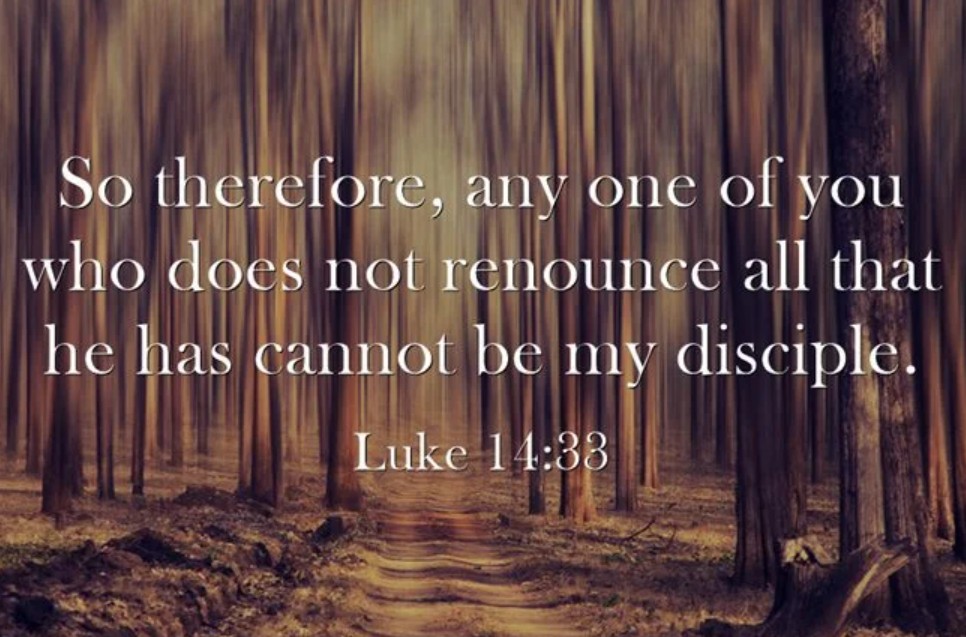
In the gospel today, Jesus is addressing a large crowd who are super eager to join him, and become his disciples.  However, Jesus bluntly dampers their enthusiasm by challenging them in a way that is off-putting.  Jesus is looking for total commitment, he is basically saying:  If you want to be my disciples, you have to think seriously first.  Do not act on the spur of the moment, or on an impulse.  It is important to give careful consideration to what it is going to cost you.  Jesus is not inviting us for a day’s or a month’s worth of commitment, but a lifetime’s worth of service.

In any big decision in life, either buying a house, a car, going on holiday, we take time to consider to options, what is it going to cost, either financially of emotionally.   The same to for discernment.  Looking into the Priesthood, Religious, or Married life, we take time to consider if it’s the right thing to do.  We talk about it to others, we reflect upon it, meditate and more importantly pray about it.  But in the end, we have to push ourselves through, in taking the next steps, that can be difficult and scary to complete.

For marriage, it’s the big step of proposing, with bended knee, with a possible fear of rejection.  Knowing that marriage is a life long commitment of caring for each other, in sickness and in health.

For men and women looking into Religious life, then it’s the solemn vows and promises you make to the Lord, in a life time of service to his Holy Church.

When I was discerning for the Priesthood, it took years for me to get the ball rolling.  In 2010, Pope Benedict came to the UK for the Beatification of Cardinal Henry Newman.  I went down, with a group from my local parish to Birmingham for the event.  It was such a wonderful occasion, and at the end of that day, I said to myself: ‘enough time thinking about the priesthood, it is now time to get the ball rolling.’  So, the next week I contacted the vocations director and started my monthly meetings.  

When the time arrived for me to sell my possessions when leaving for Oscott college, it was very difficult.  The thought of being a student again after many years, made me nervous.  Resigning from my job at Preston Hospital, giving notice for my flat, selling my furniture and being left with minimal possessions, felt very uncomfortable.  I remember the final night in my flat, I was sitting on a single stool listing to the radio on my mobile phone.  Since my TV, sofa and chairs were already sold, and my room was extremely empty.  I said to myself, with an intake of breath and a large sigh from the heart:  I hope I am doing the right thing, in the eyes of God.

I can honestly say, joining the Priesthood is the best thing I’ve ever done.  True, the training lasted for seven years in total, it had many ups and downs, but it was all part of God’s divine plan.  I heard his call and I answered, openly and honestly. 

As you know, a Priest’s main role is to administer the Sacraments of the Church and to help people in their Spiritual lives.  Focusing on saving souls, and bringing the Lord Jesus to God’s faithful people.

A priest is there throughout all the stages of ones life.  Shortly after birth, at their baptism. 

In primary school, teaching them the importance of the Sacraments of Confession and Holy Communion. 

In secondary school, teaching them to carry on with their faith themselves through the Sacrament of Confirmation. 

In Marriage, teaching them of God’s love and grace within the family home, to treat each other with respect, because we are made in the image and likeness of God. 

In Sickness, through the Sacrament of the sick and the anointing with sacred oils. 

In death and dying, through the Last Rights, before they die, asking the Lord for the remission of all their sins, through the prayer of the Apostolic pardon.

So, let us today, take the next step in our lives, by saying ‘yes’ to God’s plan, like Mary did, and we can then follow the Lord Jesus, faithfully and honestly in a lifetime of service and steadfast commitment to the building up of the Kingdom of Heaven.

Homily – Luke 14:1, 7-14

Today, Jesus instructs the guests at the Wedding celebration meal to do the opposite of what they would normally.  They were told to give up their places, so a more distinguished guest could take them.  And sit themselves at the lowest place at table.  By doing this first, they may be invited to move higher later by the host.

This is good advice for us all, especially when we go out for meals at restaurants or maybe at people’s homes. 

I remember when I was on placement as a Seminarian, when having big festive Christmas party in the presbytery in Carlisle, loads of people were invited, and I would stay towards the back of the line, heading towards the dining room, to wait for my turn to be seated.  99% of the time I would remain at the bottom end of the table, which suited me fine, away from the lime light.  But sometimes at other events, if I wasn’t concentrating, I would walk in first, and then I would get a long hard stare from the Parish Priest hosting the party to move aside for the other guests.      

The gospel message today is teaching us that reversal is better.  The last will be first, and the first last.  Everyone who exalts himself will be humbled, but the one who humbles himself will be exalted. 

We see this happen at Mary’s visitation to Elizabeth.  During Mary’s Magnificat she said, ‘the Lord looks on his servant in her lowliness, henceforth all ages will call me blessed.’ and later on she continues ‘He casts the mighty from their thrones and raises the lowly.’ 

The reason Jesus preached this message, is because he also lived it.  He humbled himself by accepting death, death on a cross.  The most humiliating and cruel means for execution in the Roman Empire.  But God the Father allowed him to be greatly exalted.  ‘When I am lifted up from the earth, I will draw all people to myself.’  Jesus being raised up on the cross was his Exaltation and Glorification for all the world to see. 

At every Mass, we are brought back to this very moment, transported back in time and space to the first and only Sacrifice of Jesus Christ on the cross at Golgotha. 

When the Eucharist is raised up by the priest in a short while, we are seeing Jesus’ Exaltation and Glorification on the cross at Golgotha.  A great sacrifice and most sacred free gift from God for the remission of our sins, that conquers all evil and wipes away our sadness from our lives.

As you know, the Mass is a foretaste of our heavenly banquet.  In the Gospel, Jesus uses the setting of a wedding to explain how we can enter the heavenly banquet ourselves in God’s Kingdom.  When we are told to humble ourselves and to help others, who can’t return the favour.  In a time with increasing food and fuel bills, many people are finding it difficult to put food on the table.  Let us all help each other, over the next few months, in this time of uncertainty, with charity and loving kindness. 

Maybe we could invite someone for a meal who are finding life tough at the minute.

We are all unworthy of the great gift of Salvation, and it is only through God’s will and love for us, that we are able to receive this sacred gift of everlasting life in Heaven.

To eat at the Lord’s heavenly banquet is ours if we truly want it, but we must trust in the Lord’s commands and humble ourselves to become last of all, to receive our eternal reward.

Homily – Luke 13:22-30

Is the Lord Jesus saying “Just be nice” ??????

The disciples asked “Lord, will those who are saved be few?”  Today is a hard Gospel teaching.  Many people will have mixed feelings and emotions, but do not be dishearten. 

I wonder why they asked Jesus this question?  Maybe, it was because after spending so much time listening to Jesus’ teachings and then realising what he was asking them to do, many of them might have thought it would be too difficult and for others impossible to follow. 

On their own, it would be very difficult, but with Jesus and the Holy Spirit, being at their side, anything is possible.  We can all be saved.  However, unfortunately, it is not under our own terms, there are rules and commandments to follow. 

In this secular world of ours today, people are probably thinking all I need to do, to go to heaven, is to ‘be nice.’ …  Just – ‘be nice’.  However, the bible is not saying that.  The bible is warning us.  The Good news is that we can all be saved, and inherit eternal life.  But the Bad news is that not everybody in the world is going down that path, that the Lord has given them, out of their own free will.

Jesus says to the disciples, ‘Try your best to enter by the narrow door, many will try to enter and will not succeed.’  Jesus gives us today a very serious dose of reality.  There are those who will make it, and those who will not.

Pope Francis explained during one of his Papal audience addresses, that the ‘narrow door’ is Jesus himself.  He is he door, He is the gateway to Salvation.  The ‘narrow door’ is made up of our responses of obedience to Jesus’ teachings.  So, the easiest way to ensure salvation is to know what Jesus is teaching, and to put it into practice, in full trust and fidelity.  To analyse our personal responses to his call, and see if our reply is good enough, if not, then we have work to do, to remedy the situation.

Life is such a wonderful gift of love from the Lord, so valuable.   Being with Jesus forever in heaven is so precious, that there is nothing on earth that is worth sacrificing and taking a chance upon.  Keep our gaze, our goal, firmly on our eternal reward. 

So, let us today seek out the ‘narrow door’ with all our hearts.  Let us obey Jesus’ commands and continue to proclaim the Good News to the world.  Rooted in the Sacraments of the Church, may our hearts and minds be ready, focused on the ultimate goal of Eternal joy of Righteousness in the Glory of Heaven, with all the Angels and Saints, celebrating in one chorus of exultant praise in the Heavenly banquet of the Lord. 

Eternal Paradise is ours if we truly want it, by following the Lord closely in Word and deed.  

So, ‘enter by the narrow door, and recline at table, in the Kingdom of God.’

Homily – Hebrews 12:1-4

Short Homily due to Bishop’s Pastoral Letter this weekend.

For people of the ancient world, just as for people today, it is hard to think of a greater thrill than to participate in the Olympic games, cheered on by the vast crowds towards the finish line.  This exhilarating scene is a far cry from Christian life of the readers of the Hebrews, who were discouraged as they were being persecuted because of their faith.  However, according to scripture, as disciples we are on a racecourse heading towards a triumphant goal.  The Saints from the past rooting for us and passionately interested in the outcome of our lives. 

This great contest calls for a decisive response, to rid ourselves of every burden.  The verb for ‘rid oneself’ can be translated to ‘lay aside’, ‘throw off’, and is often applied to what people have to discard when following the Lord Jesus. To throw off the works of darkness, rid yourselves from falsehood, anger, gossip, moral impurity, malice and deceit.  Like disciplined athletes who shed all excess body weight for the games, we should do well to remove any bulk or burden that might impede our progress from reaching the finishing line and winning our reward in Heaven.

So, let us today ask the Lord for perseverance and endurance in our Christian lives, since our race is not a sprint, but rather a distance that will include many long uphill climbs and rough terrain.  Let us keep our eyes fixed on the Lord Jesus always, since he is the one, that will bring our faith and knowledge to perfection.  With the Saints as our spectators, let us as for their intercession to help us complete the race we have started, and win a wreath that will never wither away. 

Homily – Hebrews 11:1-2, 8-19 & Luke 12:35-40

Blessed are the people the Lord has chosen as his own.’  Today’s theme is all about ‘Faith’.  We read in the second reading that it was ‘faith’ that made Abraham obey the call of God, to set out for a distant country which would become the promise land.

It was ‘faith’ that made Sarah, even in her advanced age, able to conceive a son, because she believed that God, who made the promise, would be faithful to it.

It was by ‘faith’ Abraham was put to the test and offered up Isaac as a sacrifice.  And it will be through Isaac’s line that the ‘faith’ will be carried on, to the number of descendants that cannot be counted, as many as the stars of heaven, or grains of sand on the seashore.  We are counted as those descendants as Christians, the Children of God.

However, is our soul ready for the Lord’s return?  We read in today’s Psalm ‘Our soul is waiting for the Lord, He is our help and our shield.’ 

The need to be ready and waiting is a key message in today’s Gospel ‘Blessed are those servants whom the master finds awake when he comes.’  St. Paul in his letter to the Thessalonian’s taught that we should ‘Rejoice always and pray without ceasing.’  That is why the Church has always encouraged us to pray continually throughout the day.  In the ‘Divine Office, the Liturgy of Hours’ the Church prays at least five times a day. 

This is done by religious and lay people alike.  These people who are living in all the many different time zones, are reciting the Divine Office in one continuous prayer, for the needs of the world throughout the whole day. 

This means there is always one person in the world praying for each and every one of us, interceding to the Lord on our behalf.  Therefore, ask the Holy Spirit today to make our hearts ready for the Lord’s return.

Prayer is what makes us stay awake, as the Lord will come at an hour we do not expect.  So, don’t give up, saying to our ourselves: ‘Relax, because the Master is taking his time in coming’  No, keep the Faith alive and active, keep on praying. 

Our Faith is not just about prayer, but also about works.  In the book of James, it says ‘Faith is dead, if it has no works’.  Faith and Works go together, hand in hand.  St. James believes that our faith in Jesus Christ and trusting in God, will make us feel compassionate for each other, and to act in good charity to our neighbour. 

The Gospel highlights the importance to build up Treasures in Heaven, where no thief or moth can destroy.  The lesson here is to keep God in the centre of our lives.  We should not be too busy to pray to the Lord and thanking him for the many blessings we have received.  This refers back to last week’s Gospel, of the ‘Rich Fool’ who was too busy hoarding his wealth rather than sharing it with the poor. 

So, let us today keep the Lord close to our hearts and minds, strong in Faith.  Awake, praying and being active in works of charity, making treasure for ourselves in Heaven. 

This will make us ready for the Lord’s coming, as he takes us by the hand into paradise for all eternity when he returns again.

Homily – Matthew 16:24-28

St Dominic was born in Spain in 1170.  He spent six years studying theology and four years in the arts.  In 1191 a famine hit, and many people were left desolate and homeless.  Dominic sold everything he had, including his furniture and clothes and bought food for the poor.  He also sold his study books and manuscripts saying: ‘Would you have me study from these dead skins, when people are dying of hunger?’

On two other occasions, Dominic attempted to sell himself into slavery to obtain freedom for others.

In 1194 Dominic joined a Benedictine Order of the Canons Regular in Osma, there is became the prior of the chapter in 1201.

Later he joined his bishop and they journeyed to Rome, to speak with Pope Innocent III about pursuing a new mission for the conversion of unbelievers.  The Pope sent them to south France to convert the heretics back to the true faith.  The heresy at this time was an understanding that Human beings were spirits trapped in a physical body, and all materials including the body itself were fundamentally evil. 

A group of monks known as the Cistercians were assigned to combat this heresy through prayer, fasting and instruction, but they made little headway.  St Dominic and his companions debated with the heretics but could not defend themselves, and they were threatened with violence. 

Dominic recognised the need for a physical institution in South France to help preserve the teachings of the faith against the heresies.  Dominic established the first Dominican house for Catholic women. 

In 1214 an apparition of the Virgin Mary appeared to him, and St Dominic received the Most Holy Rosary during a period of prayer at the abbey and she told him to go forth and preach to the people.  With beads in his hands, he restored the courage of the Catholic troops and led them to victory against overwhelming numbers – finally crushing the heresy completely.  The Rosary became popular following this event, suggesting that the legend of Mary’s appearance was true. 

St Dominic’s words of preaching rescued countless souls and at the young age of 51 on the 6th August 1221 he gave up his soul to God.

May we take inspiration about the life story of St Dominic, we can easily see the words of today’s Gospel working in his life. 

‘If anyone would come after me, let him deny himself and take up his cross and follow me.  Whoever would save his life will lose it, but whoever loses his life for my sake will find it.’

May we ask God for the same determination in our own lives, through devotion to prayer and helping the poor, to bring people to the true understanding of the faith.  Let us continue to be a good examples of being God’s faithful children, by building up souls for the Kingdom of Heaven.

St Dominic:  Pray for us.

Homily – Matthew 14:22-36

In the Gospel today we hear Jesus walking on the water.  A dramatic encounter with God involving an intensive manifestation of Jesus’ divine power and presence.  The disciples came face to face with the divine person of Jesus, his shroud of mystery, briefly pulled back to reveal his true identity.

At the start of this narrative, we hear Jesus didn’t not accompany his disciples in the boat.  Instead, he sends them ahead to the other side, while he stays behind.  His intention was to create an opportunity for prayer.  He seeks solitude up in the mountains to pray to His heavenly Father, in secret. 

Meanwhile the disciples were fighting against the bad weather for much of the night, the wind blowing hard against their boats, churning up big angry waves upon the sea of Galilee.  The disciples managed to get across, a few miles from shore, during the 4th watch of the night, which is between the hours of 3am to 6am.  Then they suddenly see Jesus walking towards the boat.  Their first reaction was terror, as they thought it was a ghost.  However, Jesus responds, ‘It is I’, hoping to calm their fears. 

As we know, Peter asks to join him on the water, at first things start to go well, as Peter begins to stride across the waves, his every step supported by a miracle of God.  Peter shows himself courageous towards his fellow disciples.  However, the situation quickly changes. 

Peter seeing how strong the wind was, let fear overpower his faith, Peter, took his eyes off the Lord, and he began to sink.  All Peter could do, is to cry out, saying:  Lord, Save me!

How many times in our lives do we panic and all we can do is cry out in desperation saying:  Lord, Save me! 

We all find ourselves in stormy situations, sometimes we prevail and grow stronger, sometimes we falter.  It is in these times of testing that can show us where our spiritual development is and where we need improvement, to grow in our Christian maturity.

The Lord shows himself being patient with us to, he will never abandon or allow us to drown in the midst of our personal trials.

God is with us, his hand outstretched, ready to lift us up again.

The challenge for us today, is to learn from our mistakes, like Jesus wanted Peter, to learn that distractions and doubt were the reasons for his failure at sea.  May we be encouraged, that the Lord is always at our side, we just need to call on him in prayer, by saying:  Lord, Save me! 

Homily – Luke 12:13-21

After reading today’s Gospel, I chuckled to myself as the topic of inheritance is currently a hot topic in the family at the minute.  In one area, the topic of inheritance tax my brother and I will have to spend on my mother’s estate.  And on the other, the various loans and handouts my brother is currently receiving from my parents, to spend his newish house, specifically, on new solar panels and batteries, to me, it sounds a lot like all my inheritance money is quickly disappearing down the drain.  

In Gospel we are moving away from Jesus’ teachings to the disciples about not to ‘worry’ or ‘be afraid’ about facing persecution, but now instructs the crowds not to worry about lacking of material goods.

He makes his point with the parable of the rich fool, which is unique to Luke’s Gospel.  The man is obsessed with his material goods, his only concern is about ‘my harvest, my barns, my grain’.  In contrast, Jospeh in the book of Genesis, (the one with Technicolour dream coat) when he became second in command to Pharaoh, he also collected grain abundantly, however, for the sole purpose to feed the country, and the surrounding area in times of famine.  In today’s Gospel the man was focused on himself alone, thinking that he is in total control of his life.  We hear, that he congratulates himself on having so many good things stored up, and therefore he can rest, eat, drink and be merry, knowing that he is now secure in the many years to come.  God calls him a fool, a term Jesus applies to the Pharisees earlier in the Gospel.  ‘The fool says in his heart, there is no God.’ 

Realistically, the rich man behaved as if there is no God, since he has put his trust in his possessions rather than in God.  However, his plans came to nothing, because that very night his life was demanded of him.  The ‘life’ that the man considered to be his own, was really on loan from God.  The man wishing to save his life, ended up losing it.

The lesson today is:  To always keep God in the picture.  We should always view earthly things, whether negative or positive, in the view of eternity, in the view of God’s plan for us.  This is precisely what the foolish rich man did not do.  He was too busy thinking about himself, rather than thinking about God, and thanking him for all the many blessings he has received.  Too busy hoarding his wealth, rather than sharing it with the poor.  Stored up treasure for himself, rather than treasure up in heaven.  The man was not rich in God’s eyes.  

We to, can overcome our temptation for greed, by helping those who are less fortunate than ourselves. 

What is given to others is not lost but is transformed into treasures for eternity.  Or in my brothers case, new solar panels for his house.

Regarding myself, I need to stop thinking about the safety of money after I retire, and how much I’ll be receiving from the parents after they die.  I need to remind myself of the time, I gave up my flat, my possessions, including my career in the NHS,  and handed it all over to the Lord, as I pursued a life in the Priesthood.  I said to myself then, I am going to leave it all in the Lord’s hands, and ten’s years later, being three years Ordained, I need to remember that I am still in the Lord’s hands, and to trust in him fully, building up treasures for myself in Heaven.