Homily – Matthew 16:24-28

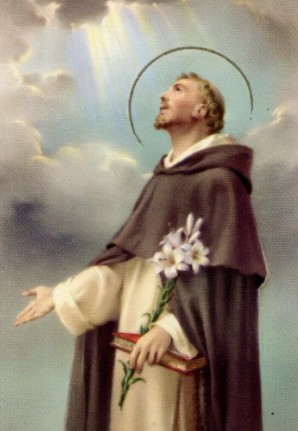
St Dominic was born in Spain in 1170.  He spent six years studying theology and four years in the arts.  In 1191 a famine hit, and many people were left desolate and homeless.  Dominic sold everything he had, including his furniture and clothes and bought food for the poor.  He also sold his study books and manuscripts saying: ‘Would you have me study from these dead skins, when people are dying of hunger?’

On two other occasions, Dominic attempted to sell himself into slavery to obtain freedom for others.

In 1194 Dominic joined a Benedictine Order of the Canons Regular in Osma, there is became the prior of the chapter in 1201.

Later he joined his bishop and they journeyed to Rome, to speak with Pope Innocent III about pursuing a new mission for the conversion of unbelievers.  The Pope sent them to south France to convert the heretics back to the true faith.  The heresy at this time was an understanding that Human beings were spirits trapped in a physical body, and all materials including the body itself were fundamentally evil. 

A group of monks known as the Cistercians were assigned to combat this heresy through prayer, fasting and instruction, but they made little headway.  St Dominic and his companions debated with the heretics but could not defend themselves, and they were threatened with violence. 

Dominic recognised the need for a physical institution in South France to help preserve the teachings of the faith against the heresies.  Dominic established the first Dominican house for Catholic women. 

In 1214 an apparition of the Virgin Mary appeared to him, and St Dominic received the Most Holy Rosary during a period of prayer at the abbey and she told him to go forth and preach to the people.  With beads in his hands, he restored the courage of the Catholic troops and led them to victory against overwhelming numbers – finally crushing the heresy completely.  The Rosary became popular following this event, suggesting that the legend of Mary’s appearance was true. 

St Dominic’s words of preaching rescued countless souls and at the young age of 51 on the 6th August 1221 he gave up his soul to God.

May we take inspiration about the life story of St Dominic, we can easily see the words of today’s Gospel working in his life. 

‘If anyone would come after me, let him deny himself and take up his cross and follow me.  Whoever would save his life will lose it, but whoever loses his life for my sake will find it.’

May we ask God for the same determination in our own lives, through devotion to prayer and helping the poor, to bring people to the true understanding of the faith.  Let us continue to be a good examples of being God’s faithful children, by building up souls for the Kingdom of Heaven.

St Dominic:  Pray for us.

Homily – Matthew 14:22-36

In the Gospel today we hear Jesus walking on the water.  A dramatic encounter with God involving an intensive manifestation of Jesus’ divine power and presence.  The disciples came face to face with the divine person of Jesus, his shroud of mystery, briefly pulled back to reveal his true identity.

At the start of this narrative, we hear Jesus didn’t not accompany his disciples in the boat.  Instead, he sends them ahead to the other side, while he stays behind.  His intention was to create an opportunity for prayer.  He seeks solitude up in the mountains to pray to His heavenly Father, in secret. 

Meanwhile the disciples were fighting against the bad weather for much of the night, the wind blowing hard against their boats, churning up big angry waves upon the sea of Galilee.  The disciples managed to get across, a few miles from shore, during the 4th watch of the night, which is between the hours of 3am to 6am.  Then they suddenly see Jesus walking towards the boat.  Their first reaction was terror, as they thought it was a ghost.  However, Jesus responds, ‘It is I’, hoping to calm their fears. 

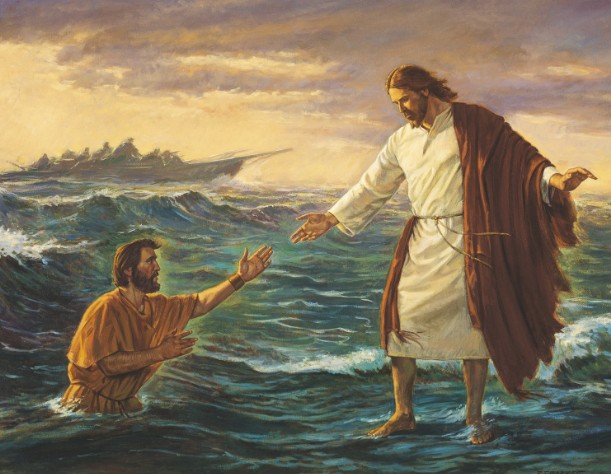
As we know, Peter asks to join him on the water, at first things start to go well, as Peter begins to stride across the waves, his every step supported by a miracle of God.  Peter shows himself courageous towards his fellow disciples.  However, the situation quickly changes. 

Peter seeing how strong the wind was, let fear overpower his faith, Peter, took his eyes off the Lord, and he began to sink.  All Peter could do, is to cry out, saying:  Lord, Save me!

How many times in our lives do we panic and all we can do is cry out in desperation saying:  Lord, Save me! 

We all find ourselves in stormy situations, sometimes we prevail and grow stronger, sometimes we falter.  It is in these times of testing that can show us where our spiritual development is and where we need improvement, to grow in our Christian maturity.

The Lord shows himself being patient with us to, he will never abandon or allow us to drown in the midst of our personal trials.

God is with us, his hand outstretched, ready to lift us up again.

The challenge for us today, is to learn from our mistakes, like Jesus wanted Peter, to learn that distractions and doubt were the reasons for his failure at sea.  May we be encouraged, that the Lord is always at our side, we just need to call on him in prayer, by saying:  Lord, Save me! 

Homily – Luke 12:13-21

After reading today’s Gospel, I chuckled to myself as the topic of inheritance is currently a hot topic in the family at the minute.  In one area, the topic of inheritance tax my brother and I will have to spend on my mother’s estate.  And on the other, the various loans and handouts my brother is currently receiving from my parents, to spend his newish house, specifically, on new solar panels and batteries, to me, it sounds a lot like all my inheritance money is quickly disappearing down the drain.  

In Gospel we are moving away from Jesus’ teachings to the disciples about not to ‘worry’ or ‘be afraid’ about facing persecution, but now instructs the crowds not to worry about lacking of material goods.

He makes his point with the parable of the rich fool, which is unique to Luke’s Gospel.  The man is obsessed with his material goods, his only concern is about ‘my harvest, my barns, my grain’.  In contrast, Jospeh in the book of Genesis, (the one with Technicolour dream coat) when he became second in command to Pharaoh, he also collected grain abundantly, however, for the sole purpose to feed the country, and the surrounding area in times of famine.  In today’s Gospel the man was focused on himself alone, thinking that he is in total control of his life.  We hear, that he congratulates himself on having so many good things stored up, and therefore he can rest, eat, drink and be merry, knowing that he is now secure in the many years to come.  God calls him a fool, a term Jesus applies to the Pharisees earlier in the Gospel.  ‘The fool says in his heart, there is no God.’ 

Realistically, the rich man behaved as if there is no God, since he has put his trust in his possessions rather than in God.  However, his plans came to nothing, because that very night his life was demanded of him.  The ‘life’ that the man considered to be his own, was really on loan from God.  The man wishing to save his life, ended up losing it.

The lesson today is:  To always keep God in the picture.  We should always view earthly things, whether negative or positive, in the view of eternity, in the view of God’s plan for us.  This is precisely what the foolish rich man did not do.  He was too busy thinking about himself, rather than thinking about God, and thanking him for all the many blessings he has received.  Too busy hoarding his wealth, rather than sharing it with the poor.  Stored up treasure for himself, rather than treasure up in heaven.  The man was not rich in God’s eyes.  

We to, can overcome our temptation for greed, by helping those who are less fortunate than ourselves. 

What is given to others is not lost but is transformed into treasures for eternity.  Or in my brothers case, new solar panels for his house.

Regarding myself, I need to stop thinking about the safety of money after I retire, and how much I’ll be receiving from the parents after they die.  I need to remind myself of the time, I gave up my flat, my possessions, including my career in the NHS,  and handed it all over to the Lord, as I pursued a life in the Priesthood.  I said to myself then, I am going to leave it all in the Lord’s hands, and ten’s years later, being three years Ordained, I need to remember that I am still in the Lord’s hands, and to trust in him fully, building up treasures for myself in Heaven.  

Homily – Luke 10:25-37

‘Who is my neighbour?’ this is the key question in today’s Gospel.  We hear about the parable of the Good Samaritan.  A man who did all he could for his neighbour, a beaten man, lying half dead on the ground.  He patched him up and took him to a nearby Inn to be looked after, even paying extra expenses to the inn keeper.  Why the extra money, you may ask?  Because if the money had ran out, the Inn Keeper was well within his rights, to sell him into slavery to be reimbursed.  This man would have ended up in a worst situation, than he was before.  The Good Samaritan covered all the bases, to give the beaten man the best chance possible for recovery.  The Samaritan was surely a man of mercy and compassion for his neighbour.

Today is Sea Sunday, and we remember all the hard work the Catholic Organisation of Stella Maris do around the world.  Chaplains who bear the burden of dealing with the many hardships of our Fishers & Seafarers, who work in very challenging conditions out at Sea, for our benefit, bringing food and goods into the UK.

There are many reports that crew members are getting only a few hours of sleep per night, due to stress and being overworked.  This is making their safety vulnerable because they are completely exhausted.  Stella Maris, are able to ground ships, allowing the crew to get some much needed rest.  They also provide warm dry clothes and phone cards to many who are feeling homesick.   

The work of Chaplains in our ports provide support in emergencies, and giving spiritual and emotional support to Seafarers all around the world. 

May the Lord provide them with grace and support that they need to carry the ‘yoke’ of their ministries, as they administer to God’s faithful people at sea.

We also remember all our lost souls who have tragically lost their lives at sea.  It is getting more and more common now in the news, with small inflatable dinghies crossing from France to England capsizing and sinking.  We keep all the faithful departed in our prayers. 

On this day, I seem to remember the movie Titanic.  The big sea disaster, about a ship that was said to be unsinkable, hitting an iceberg on its way to America.  In the movie, you may recall, if you’ve seen it, a group of musicians, who sacrificed their lives to bring peace and harmony during the time of the disaster, by playing hymns and classical music, while the Titanic was sinking.

It sank on the 15th April 1912, and 1,503 souls were lost in the icy waters.  Onboard the Titanic was a 42 year old priest called Fr Thomas Byles, and he is known for his heroic actions during the sinking.  On this 10th anniversary of his priesthood, he decided to visit his brother in New York, so he bought a 2nd classed tickets for the Titanic. 

While onboard he would celebrate Mass for the 2nd and 3rd class passengers, and during his last sermon on the boat, he explained that the prayers and Sacraments of the Church were our spiritual lifeboats, to use when we are in danger from our spiritual shipwrecks of temptation.

According to eyewitnesses, Fr Thomas was out on deck praying his breviary shortly before midnight, when the ship hit the iceberg. 

When the captain ordered the launching of the lifeboats, Fr Thomas made his way down to help people navigate the stairwells to the upper deck, but many found themselves trapped behind locked iron gates.  Fr Thomas calmly led the third-class passengers to where the lifeboats were located. 

He was also offered a place on the Lifeboat, but he refused.  When the ship was going down Fr Thomas was with people from all different religions, resighting the rosary together, while Fr Thomas was praying for the repose of their souls, as he administered the Last Rites, giving them general absolution for their sins. 

Fr Thomas was an extraordinary man, who gave his life for others, and his actions were praised by Pope Pius X. 

So today, may we keep the work of Sea chaplains in our prayers, and the support the Stella Maris Catholic Organisation.  May the Lord watch over all the faithful departed who have been lost at Sea and bring them into eternal life.  Amen. 

Homily – Matthew 24:4-13

The First Martyrs of Rome stand out as powerful witnesses to the faith.  Their stories, marked by unparalleled courage and horrific suffering, that developed against the backdrop of the Great Fire of Rome in 64AD.

This fire blazed for nine days, consuming vast sections of the city, by the time the fire was out, two-thirds of Rome lay in ruins.

Facing mounting public outrage and a desperate effort to deflect the blame onto someone, Emperor Nero needed a scapegoat, someone to hold responsible.  He found one in the ever increasing Christian community, a relatively new and misunderstood religious group in Rome.  Christians were already viewed with suspicion due to their refusal to participate in the traditional Roman practices at the time.  Christians were arrested en masse, subjected to public scorn, and condemned to die gruesome deaths. 

The methods of execution were designed not only to kill, but to inflict maximum amount of terror and humiliation.  Many were sewn into the skins of wild animals and thrown into a pack of wild dogs from them to eat.  Others were crucified.  Others again, were smeared with oil and wax, placed on stakes and set alight to serve as human torches in the streets and gardens.

The martyrdom of these early Christians had a great impact on the Roman world. 

The steadfastness and faith of the martyrs in the face of such extreme persecution served as a powerful testimony to the truth of their beliefs.  Their willingness to endure unimaginable suffering rather than renounce their faith, helped others to embrace and join the Christian community.

The memory of the First Martyrs of Rome inspired and strengthened Christianity.  Their sacrifice laid a foundation for growth in the Church, which would ultimately spread throughout of the whole Roman Empire and beyond.

Their legacy is a testament to the resilience of the human spirit and the transformative power of faith and prayer in the face of such evil.

As we ponder these unnamed heroes, we continue to look up to Saints Peter and Paul whose feast day was yesterday, Martyrs of the faith.  Let them be our inspiration to follow them, in the footsteps of Christ Jesus, with zeal for spreading the Gospel message to the people of our world today.

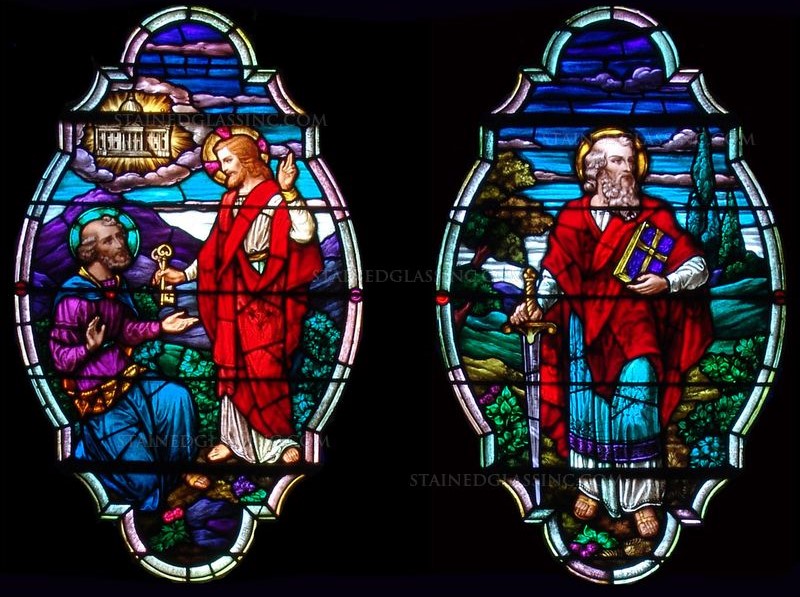
Homily – Matthew 16:13-19

Today we remember two great Apostles, two pillars of the Church, St Peter and St Paul.  At the heart of their stories we hear an encounter with Jesus that changed their lives.  They both received the love that healed them and set them free.

As we know Peter was a very skilled fisherman from Galilee, but we hear in the Gospels, that many times, he tasted the bitterness of frustration, especially when he hadn’t caught anything all night.  He was tempted to pull up his oars and give up.  Nevertheless, Jesus loved Peter and encouraged him not to give up, asking him to lower his nets once more, or maybe joining him to walk on the water, or finding the strength to accept his own frailty, and giving his life for his friends by becoming a ‘shepherd of the flock’.  In this way, Jesus sets Peter free from fear and all worldly concerns.  He gave him the courage to risk everything and the joy of becoming a fisher of men, by coming the first Pope of the Catholic Church.

When Peter denied Jesus three times, in the courtyard at Jesus’ trial, while keeping warm over a charcoal fire, he rejected his relationship with Jesus, by saying: ‘he didn’t know the man.’  After the Resurrection, Jesus gives Peter the opportunity to undo that rejection.  Through Jesus’ great love and mercy he invites Peter to repent and return to him by professing his love for him three times, this act undoes the threefold denial in the courtyard, and so restores the relationship between them both. 

Jesus’ mercy is so complete, that he does not hold anything against Peter, but instead, gives him the honour and the responsibility of serving him as the ‘Shepherd of his people’.

St Paul also experienced the freedom that was brought by Jesus.  He was set free from the slavery of himself.  From Saul he became Paul, and moved away from being a zealous defender of his ancestral traditions, into a zealous defender of the Faith in Jesus Christ.    

He became open to the love of God and was given the mission to evangelise to the Pagans.  The strain of his physical health, the violence and persecution towards him, being shipwrecked several times, the daily pains of hunger and thirst, and finally in his own words: the painful thorn in the flesh, didn’t make him give up. 

St Paul came to realise that God chose what is weak in the world to shame the strong, and we are able to do all things through Jesus who strengthens us and nourishes us, since nothing can ever separate us from the love of the Father.

The Church looks towards these two giants of faith and sees two Apostles who were set free by their encounter with the Lord.  Jesus did not judge them, instead he shared their life with affection and closeness.  He supported them by his prayers, and at times reproached them to make amends.  To Peter, Jesus said gently ‘I have prayed for you that your own faith may not fail.’  And to Paul he said, ‘Saul, Saul, why are you persecuting me?’

Jesus speaks the same with us, but re-assures us of his closeness through prayer by interceding on our behalf before the Father. 

May we continue to mould ourselves closer to the Lord’s Love, making us holier in his sight, by the receiving of the Most Holy Eucharist.  When times are tough, may we never give up, asking the Lord for strength and guidance. 

We are the Children of God, united together in the ‘Body of Christ’ within the One, Holy, Catholic, and Apostolic Church, with St Peter as our Rock and St Paul as our zealous defender of love and faith. 

May we call on their intercession today, to encounter the Lord in our own lives bringing us joy, happiness and peace.

St Peter & St Paul – Pray for us.

Homily – Luke 9:11-17

Today we pay special homage to the real presence of Jesus Christ in the Eucharist.  A great opportunity to reflect upon God’s gift to us and to deepen our appreciation of the real presence of Jesus.  He is the living bread sent down from heaven, food for our souls and to satisfy our deepest spiritual hunger. 

We are pilgrims on our life’s journey, and on this road, we suffer from many hungers, but the greatest hunger of all is the yearning for a deeper meaning to life itself.  In our daily battle, we find our purpose in the Eucharist, as we are invited to follow in the footsteps of Jesus.  The Holy Eucharist is the ‘source and summit of the Christian life.’  It is the real presence of Christ amongst us, Body and Blood, Soul and Divinity.  Not only does the Eucharist unite believers to Christ, but it also unites us to one another. 

Henri de Lubac writes “The Eucharist makes the Church.”  So, if the Holy Spirit is the soul of the Church, then the Eucharist is its ‘beating heart’, pumping Christ’s blood through the members of his Body, the Church. 

By receiving of the Most Holy Body and Blood of Christ we are uniting our souls with Christ himself.  Through our Baptism, we become members of his Body, and we receive His out pouring of love and grace.  A grace that restores our health and gives us joy in our hearts.

Pope Urban says: “In this sacrament we celebrate in thanksgiving the memory of our Saviour, we are drawn away from evil, we are strengthened in what is good, and we advanced and increase in virtue and in grace.”  

So, what was the true reason behind Jesus’ institution of this precious gift?  Jesus has poured out in Sacramental riches, His Divine Love for each one of us, causing His wonderful works to be remembered and celebrated in his memory.  By doing so, we are proclaiming His Death until He comes again to judge the world. 

This precious Sacrament is to be received as our spiritual food for our soul journey, which will nourish and strengthen us.  The Sacrament will become a remedy to free us from our daily faults, and to be a pledge of our future glory of everlasting happiness in Heaven.  

With Jesus being our ‘Head,’ and we as members of his Body, we are linked by the closest of bonds, of faith, hope and love.  Since He is the ‘True Vine, and we are the Branches’, this enables us to pronounce the same faith in one unison of exultant praise.

If we are ready to grow in holiness and love, we must make the Eucharist the centre of our being, because in doing so, we make Christ the centre of our lives.  If we receive and worship Christ worthily, He will fill us with His grace and enlarge our hearts to love and serve humankind more perfectly. 

Let me finish by quoting St Teresa of Calcutta: “If we truly understand the Eucharist; if we make the Eucharist the central focus of our lives; if we feed our lives with the Eucharist, we will not find it difficult to discover Christ, to love Him, and to serve Him in the poor.

Let us take these words into our hearts today, and to go out touching the lives of others with God’s love, to be the healing presence, the helping hand, the sympathetic voice, and the words of encouragement when people need it the most.  In this way we will shape ourselves by what we receive in our daily food.  Jesus Christ Himself.

Homily – John 16:12-15

Today, we come face to face with the inner mystery of God as a family of three persons.  Father, Son and the Holy Spirit.  A complete harmony of love. 

When you hear the word ‘God’ who do you immediately think of?  How do you visualise God?  Do you automatically think of the Trinity, or just one person in the Trinity?  I remember one of my interview questions for the priesthood was: ‘Who do you pray to?’  That was an interesting question, a question that caught me off guard, something I had to ponder upon.  Who do I pray to?  For me, in my private prayers, it will be probably be Jesus Christ, however, in other areas in my priestly ministry, it will be a mixture of praying to God the Father, and also to the Holy Spirit.  

The word ‘God’ is the most used and also abused word in the human language.  The challenge for us, is to always speak rightly about God and his Holy Name, with honour, praise and worship, being extremely careful not to be disrespectful by using the Lord God’s name in vain, in anyway shape or form.

The Trinity is central to the Liturgy of the Mass, even by our first action entering the church we make the ‘sign of the cross’ with Holy Water, as we remember the Trinity, through our Baptism of the Faith.  Then the Trinity pops up again at the general greeting by the Priest, using this formular of words:  ‘The grace of the Lord Jesus Christ, the love of God, and the communion of the Holy Spirit be with you all.

The central part in the Mass where the Trinity is recalled is during the Eucharistic Prayer.  With the priest being ‘in persona Christi’ – the ‘person of Christ’, Jesus offers up the gifts of bread and wine to God the Father, and calling down the Holy Spirit upon them, during the laying on of hands over the gifts, which is called the ‘Epiclesis’.  Through the words of Christ in the Eucharistic Prayer, the gifts are changed in substance into the Body and Blood of Our Lord, Jesus Christ. 

So, you can see the three persons of the Trinity at work here.  Jesus is offering the gifts to the Heavenly Father, and the Holy Spirit is changing them into our Eucharistic food.    

In our daily lives we also need to remember how important the Trinity is to us.  We are children of God, a Father who cares for us, and in Jesus Christ we have a brother, who died for us.  In the Holy Spirit we possess a friend and a comforter, who strengthens and protects us. 

The Trinity is our personal invitation to discover and deepen our relationship with God.  We are made in the image and likeness of God, and so we should strive to become like him as much as humanly possible.  Since our destiny from this life, is to be with God, eternally in Heaven, where we will see our Creator face to face.

The Trinity is so important in the faith of the Church.  We are Baptised in the Name of the Trinity.  We profess the Trinity in the Creed each Sunday:

‘I believe in one God, the Father Almighty …’. 

‘I believe in one Lord Jesus Christ, only begotten Son of God…’ 

‘I believe in the Holy Spirit, the Lord, the giver of life…’ 

To embrace the Creed, we enter into communion with the Holy Trinity and also with the whole Church.  The Creed is our spiritual seal, our hearts meditation, and a treasure for our souls, allowing us even more, to come closer to God the Almighty. 

So, let our Christian lives mirror the life of the Trinity today, allowing the grace of our Lord Jesus Christ, the love of God, and the Communion of the Holy Spirit, to govern our words, actions, and deeds. 

Through our Baptism we have pledged to live our lives under the protection of the Most Holy Trinity, allowing the Spirit to inspire us, by bring us closer each day to the knowledge and love of God, since the Father sent his Son, so that through Him the world might be saved.

Homily – Acts of the Apostles 2:1-11

Acts 2:1-11

We are here on this wonderful occasion, a birthday celebration of the Church.  I feel we should have party poppers to mark the celebration, but I feel the church cleaning team, will never forgive me. 

As we have heard in our scripture readings, that the early disciples of Christ who were around 120 men and women were all gathered in prayer in the upper room.  Now the mission of Jesus, to be the light for the Gentiles and the glory for God’s people, is now to be given to his followers, by the empowerment of the Holy Spirit. 

This powerful roaring wind, rushing through the windows and doors of the house that that descended upon the disciples, must have been terrifying to behold.  However, the Holy Spirit gave these timid and frightened followers the courage to rush out into the streets and fearlessly preach the ‘Word of God’ to friends and foe alike, about the Passion, Death, Resurrection & Ascension of Jesus Christ, the Messiah. 

At that time, Jerusalem was packed with visiting people, because it was the Jewish Feast of Weeks, that was celebrated 50 days after Passover.  It was a commemoration of God giving them the covenant and the law on Mount Sinai.  For us Christians, the coming of the Holy Spirit at Pentecost fulfils this. 

The Lord’s gift of the law on Mount Sinai, now embraces the giving of the New Law in the Spirit, that is firmly written in our hearts as Baptised Children of God. 

The visible sign of ‘tongues of fire’, should also help us recall the words in scripture from the lips of John the Baptist’s prophecy about the One who is to come: ‘He will baptise you with the Holy Spirit and with fire.’  Now, with the visitors in Jerusalem, out in the streets, they were all astounded, and couldn’t understand what was happening.  The countries that were mentioned in the Act of the Apostles covered most of the world that was known to first century Palestine.  This symbolises the fact that the Christian Church will embrace the whole world, transcending all barriers of race, class, and nation.  They include the regions of Israel’s historic enemies like Mesopotamia which was the centre of the Assyrian and Babylonian Empires.  This is to fulfil God’s promise, that Israel’s enemies would one day turn and acknowledge the God of Israel as the true and only God.

We as Christians, who are grounded firmly by the Holy Spirit, can see how indispensable the Spirit is to us, in faith and salvation.  The indwelling of the Spirit bestows on us the theological virtues of faith, hope and love, from which all other Christian virtues and actions follow.  The Holy Spirit produces a particular kind of fruit within us, that fruit being the character and person of Jesus Christ Himself.

The descent of the Holy Spirit at Pentecost transformed the first disciples, who had previously hidden away in fear and unable to understand God’s plan for the crucified Messiah.  After receiving of the Spirit, they understood God’s saving plan and were bold enough to preach the Good News, even at the cost of beatings, imprisonment, and martyrdom. 

The disciples were filled with joy and praise, so, let us also be joyfully today, empowered and recharged by God’s gracious gift of the Holy Spirit.  May we become fruitful in our lives by bringing God’s message to the world with no fear or hesitation.

We are God’s One, Holy, Catholic and Apostolic Church, formed 1,992 years ago, and we are still going strong with around 2.4 billion Christians worldwide.  So, let us praise the Lord for his promise to Abraham, our Father in Faith, as he said:  “I will make your descendants as numerous as the stars of heaven and grains of sand on the seashore.”