St. John Vianney – 4 August

St. John Mary Vianney was born near Lyons, France, in 1786. As a child he took care of his father’s sheep. He loved to pray and when he was eighteen, he asked his father’s permission to become a priest. His father was worried about losing his help on the family farm. After two years, however, Mr. Vianney agreed. At twenty, John studied under Father Balley. The priest was very patient but Latin soon became a major problem for John. He became discouraged. It was then that he decided to walk sixty miles to the shrine of St. John Francis Regis, a popular saint in France. John prayed for help. After that pilgrimage, he still had as much trouble as ever with his studies. But he never again grew discouraged.

John was finally able to enter the seminary. Studies were hard. No matter how much he tried, he never did very well. When the final examinations came, they were spoken, not written. John had to face a board of teachers and answer their questions. He was so upset that he broke down in the middle of the test. Father Balley spoke up for John. He pointed out that John was a good and holy man, he was full of common sense, and he understood what the Church taught about the faith. It was agreed that these qualities made up for what John was lacking in learning. John was ordained.

At first, he was appointed as Father Balley’s curate, assisting him until his death in 1817. Then Father Vianney was sent to a little parish called Ars, where he would spend the rest of his life. When he first arrived, the people of Ars did not care much about their faith. They drank too much, worked all day Sunday, and never went to church. Many used terrible language. Father Vianney fasted and did penance for his people. He tried to stop them from sinning. Eventually, one tavern after another closed down because business became so slow. People began to worship regularly on Sundays and attended weekday Mass. The swearing was not so frequent. What had happened in Ars? “Our priest is a saint,” the people would say, “and we must obey him.”

God gave John the power to see into people’s minds and to know the future. Because of this gift, he converted many sinners and helped people make the right decisions. Hundreds of pilgrims began to come to Ars each day. St. John Vianney often spent sixteen hours daily hearing confessions. Even though he felt he would be happier and more at peace in a monastery, he remained at Ars for forty-two years and died there in 1859 at the age of seventy-three. St. John Vianney was proclaimed a saint in 1925 by Pope Pius XI.

St. John Vianney devoted an enormous amount of time to the Sacrament of Reconciliation. In this sacrament, our sins are forgiven and we receive the graces we need to live our life according to the teachings of Jesus. Let’s make it a point to take advantage of this sacrament by going to confession more frequently.
St. Alphonsus Liguori – 1 August.

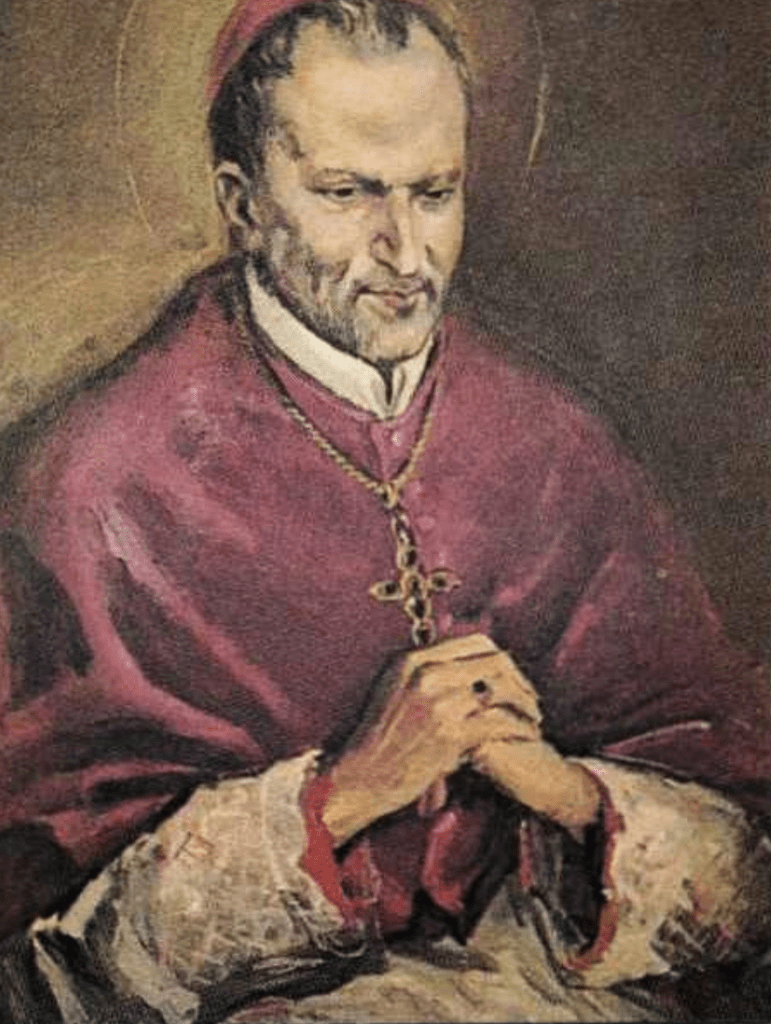
St. Alphonsus was born near Naples, Italy, in 1696. He received his degree in law at the age of sixteen and became a successful lawyer. But a mistake he made in court caused him to lose an important case, and Alphonsus decided to leave his practice to follow his true calling to be a priest. His father, who had high expectations for his son, tried to persuade him not to do it. However, Alphonsus had made up his mind. He joined the Oratorians and was ordained in 1726. His life was filled with activity. He preached and wrote books. He started a religious congregation called the Redemptorists. Alphonsus offered wise spiritual direction and brought peace to people through the Sacrament of Reconciliation. He also wrote hymns, played the organ, and painted pictures.
St. Alphonsus wrote sixty books. This is incredible considering his many other responsibilities. He also was often sick. He had frequent headaches, but would hold something cold against his forehead and keep doing his work.

Although he was naturally inclined to be hasty, Alphonsus tried to control himself. He became so humble that when the pope wanted to make him a bishop in 1762, he gently said “no.” When the pope’s messengers had come in person to tell him of the pope’s choice, they called Alphonsus “Most illustrious Lord.” Alphonsus said, “Please don’t call me that again. It would kill me.” The pope knew that Alphonsus would help the church greatly and appointed him bishop of St. Agatha of the Goths. Alphonsus sent many preachers all over his diocese. The people needed to be reminded again of the love of God and the importance of their religion. Alphonsus told the priests to preach simple sermons. “I never preached a sermon that the simplest person in the church could not understand,” he said.

As he got older, St. Alphonsus suffered from illnesses. He had painful rheumatism and became crippled. He grew deaf and almost blind. He also had disappointments and suffered from depression. But he had great devotion to the Blessed Mother as we know from his famous book called The Glories of Mary. The trials were followed by great peace and joy and a holy death.
Alphonsus died in 1787 at the age of ninety-one. Pope Gregory XVI proclaimed him a saint in 1839. Pope Pius IX proclaimed him a Doctor of the Church in 1871.

St. Alphonsus wrote many prayers, one of them we use today, especially throughout this pandemic, when we could not receive holy communion. We say his prayer when we make an act of spiritual communion.

“My Jesus, I believe that You are present in the Most Holy Sacrament of the Altar. I love You above all things, and I desire to receive You into my soul. Since I cannot at this moment receive You sacramentally, come at least spiritually into my heart. I embrace You as if You were already there and unite myself wholly to You. Never permit me to be separated from You. Amen.”

St. Martha – 29 July

Martha was the sister of Mary and Lazarus. They lived in the little town of Bethany near Jerusalem. They were dear friends of Jesus, and he often came to visit them. In fact, the Gospel tells us: “Jesus loved Martha, and her sister Mary and Lazarus.” It was St. Martha who lovingly served the Lord when he visited them.

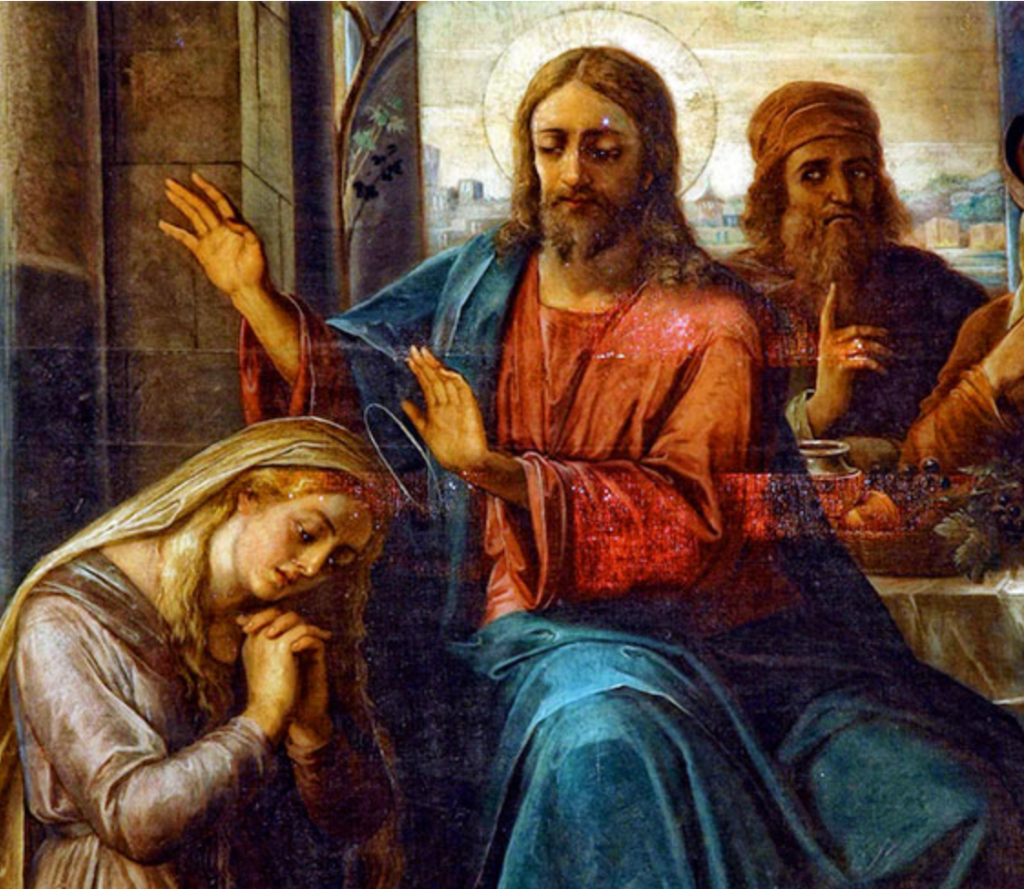
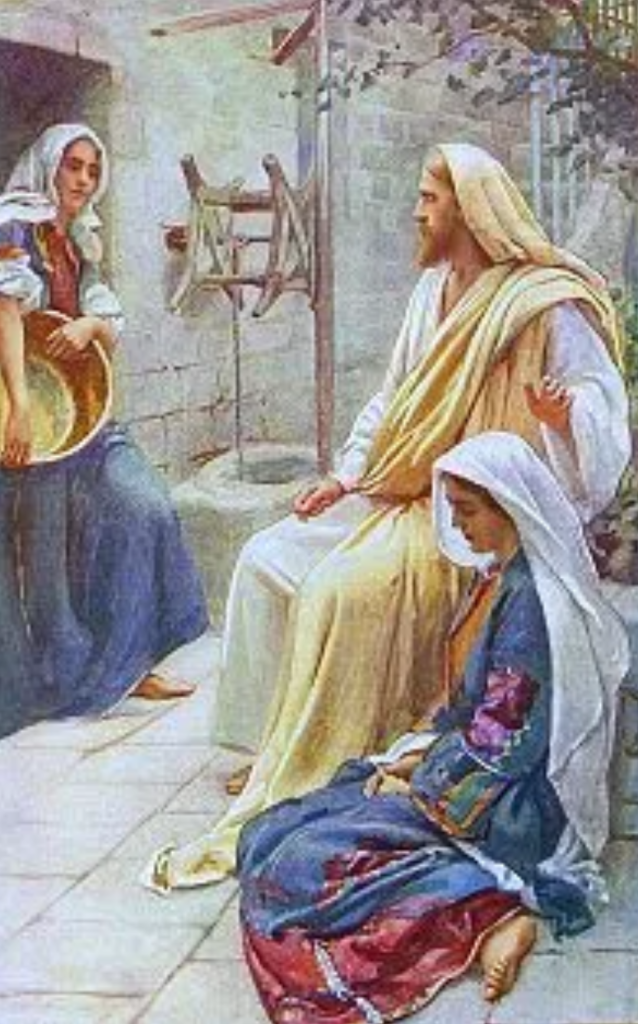
One day, she was preparing a meal for Jesus and his disciples. She realized that the task would be easier if her sister would help. She watched Mary sitting quietly at Jesus’ feet, listening to him. “Lord, tell my sister to help me,” Martha suggested. Jesus was very pleased with Martha’s loving service. However, he wanted her to know that listening to God’s Word and praying is even more important. So he said gently, “Martha, Martha, you are anxious about many things, but only one thing is necessary. Mary has chosen the better part.”

St. Martha’s great faith in Jesus was seen when her brother Lazarus died. As soon as she heard that Jesus was coming to Bethany, Martha went to meet him. She trusted Jesus and felt the freedom to say: “Lord, if you had been here, my brother would not have died.” Then Jesus told her that Lazarus would rise. He said, “He who believes in me, even if he die, shall live. Do you believe this?” And Martha answered, “Yes, Lord, I believe that you are the Christ, the Son of God, who has come into the world.” Jesus worked a great miracle and raised Lazarus from the dead!

Later, Jesus came again to have supper with Lazarus, Martha, and Mary. St. Martha served them at table as usual. This time, though, Martha had a much more loving attitude. She served with a joyful heart.

St. Martha is an example of hospitality. When we welcome and serve others, Jesus considers it as done to himself. St. Martha is also a model of faith and trust. She was a close friend of Jesus and knew she could believe his every word. She’ll help us to develop a close relationship with the Lord as well.

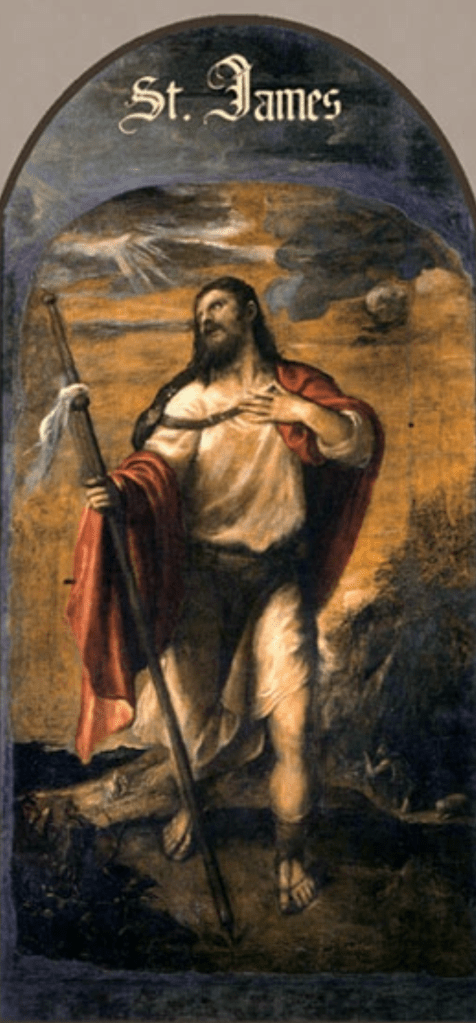
St. James, apostle – 25 July

St. James was a fisherman like his father Zebedee and his brother John. He was on his father’s boat mending his nets when the Lord passed by. Jesus called James and John to become fishers of people, to join him in spreading the Good News. Zebedee watched as his two sons left the boat to follow Jesus.

With St. Peter and St. John, James was a special companion of Jesus. With them James was permitted to witness what the other apostles did not see. With them he watched as Jesus raised the daughter of Jairus to life. With them he was taken up the mountain to see Jesus shining like the sun, with his robes as white as snow. This event is called Jesus’ Transfiguration. On Holy Thursday, the night before he died, Jesus led the apostles into the garden of Gethsemane. Matthew’s Gospel tells us he invited Peter, James, and John to accompany him to a secluded area to pray. They watched as the Master’s face became saddened with grief. It was a very difficult time for the Lord, but the apostles were exhausted. They fell asleep. Then St. James ran in fear when the enemies of Jesus took him away. James was not near the foot of the cross on Good Friday. But the Lord met up with him on Easter Sunday evening in the upper room. The resurrected Jesus came through the locked door and said, “Peace be to you.” St. James and the other apostles would find that peace after the Holy Spirit’s coming on Pentecost.

St. James began his ministry as an impulsive, outspoken man. He asked Jesus bluntly for a seat of honor in his kingdom. He demanded that Jesus send fire down on the villages that did not receive the Lord. But he had great faith in Jesus. Eventually, James learned to become humble and gentle. And he did become “first” in a way he could never have imagined. He was given the honor of being the first apostle to die for Jesus. Chapter 12 of the Acts of the Apostles tells us that King Herod Agrippa had St. James put to death by the sword. As a martyr James gave the greatest witness of all.

The Martyrs of Cumbria – 24 July

Today we remember ten martyrs who were born in the present county of Cumbria and who were all martyred elsewhere except Blessed Christopher Robinson who was born, worked, and was martyred in Carlisle. They include St. John Boste, along with Blessed John Mason, layman, Thomas Somers, James Duckett, layman, Thomas Tunstall OSB, William Ward, John Duckett, Thomas Pickering OSB, and Thomas Sprott. Today we give thanks for the witness of the martyrs which always calls us to a life of strong and generous faith.

Blessed Christopher Robinson, the Carlisle Martyr

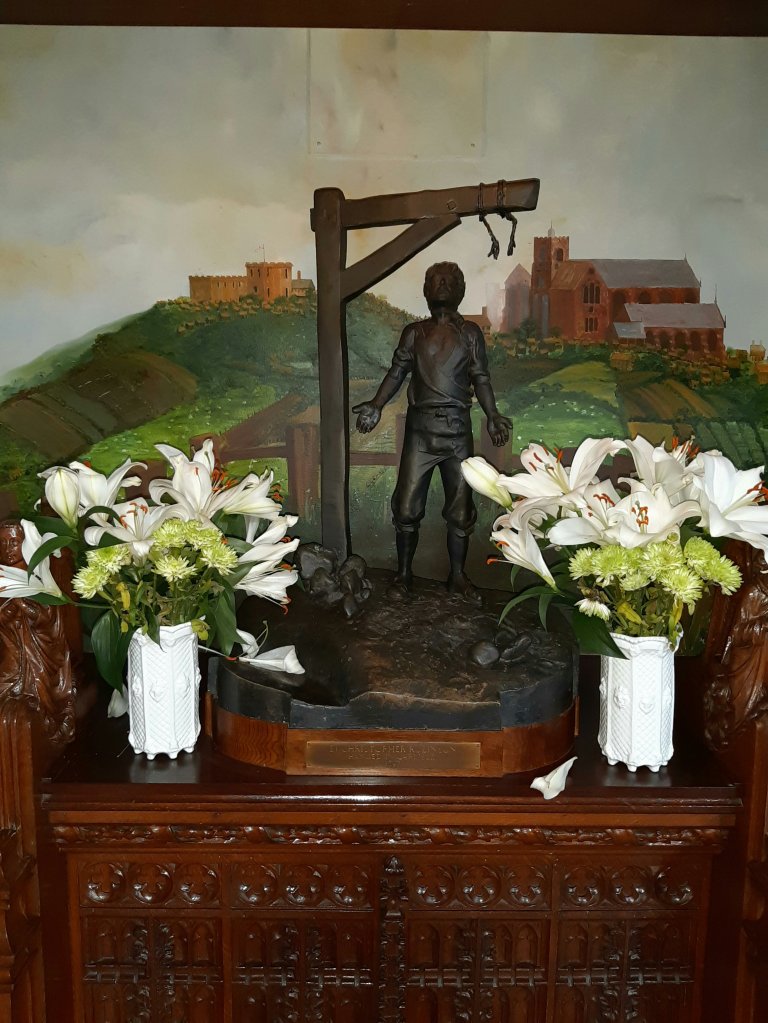
Blessed Christopher Robinson was executed at Carlisle on August 19, 1598. The model above reflects the circumstances of his martyrdom, as the rope on which he was to be hung kept breaking!  Christopher Robinson is on all the ancient lists of those martyred during the Reformation, but his life is still little known. Nevertheless, his memory has never been effaced in Cumberland, of which he is the only Catholic martyr. His death evidently made a deep impression especially in his native Carlisle.

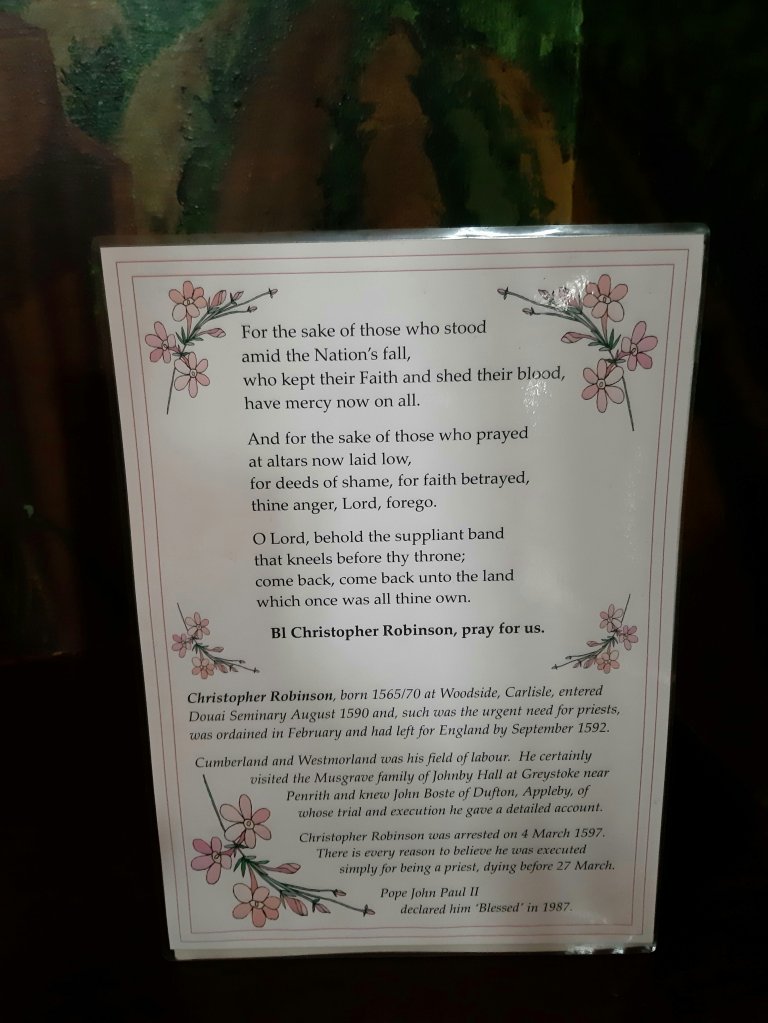
Christopher Robinson was probably born at Woodside, near Carlisle, between 1565 and 1570. He was admitted as a student with six others on 17 August 1590 at Douai as a student. This college had been founded on 29 September 1568 by William Allen, a former Oxford Professor and later Cardinal. The first four priests were sent to England in 1574, and in the next ten years just over a hundred left the College ordained for the English Mission. From 1568 to 1594 the College was re-settled beside the university of Rheims and it was during this period that Christopher Robinson was a student of the College.

He was at once entered for theological studies and was given the tonsure and first Minor Orders on 18 August 1590. Such was the urgent need for priests that the College had been granted a general dispensation to shorten the usual six-year course of preparation for the priesthood. Christopher Robinson was given the remaining Minor Orders, together with the subdiaconate and diaconate, on the last three days of March 1591. On 24 February he was ordained to the priesthood by Cardinal Philip Sega in his private chapel at Rheims. He departed for England on 1 September 1592.

Cumberland and probably part of Westmorland was to be his field of labour. In a list of 1596 he is described by name as ‘dwelling for the most part at Woodside nigh Carlisle in Cumberland’. The only house known with certainty to have been visited and used by him was Johnby Hall, the home of the Musgrave family, about six miles from Penrith, near Greystoke Castle.
He would surely have known John Boste, a native of Dufton, near Appleby, who was the most hunted priest in the northern counties. He was eventually captured near Brancepeth, County Durham, on 13 September 1593. Christopher Robinson heard of his capture and, feeling sure no one would recognise him, rode over to attend his trial. Afterwards he wrote a detailed account of the trial and death of John Boste. This is a unique, first hand evidence of a martyrdom, hardly paralleled elsewhere.

He himself was arrested three and a half years later on 4 March 1597. A letter by Fr. Henry Garnett SJ dated 7 April 1597 states:
‘One Robinson, a seminary priest, was lately in a purchased gaol-delivery hanged at Carlisle. The rope broke twice and the third time he rebuked the sheriff for cruelty saying that, although he meant no way to yield but was glad of the combat, yet flesh and blood were weak, and therefore he showed little humanity to torment a man for so long. And when they took order to put two ropes, then, said he, by this means I shall be longer a-dying, but it is no matter, I am willing to suffer all.’
Although the indictment upon which Christopher Robinson suffered is no longer to be found, there is abundant evidence that the cause of his death was his priesthood.
There is also much evidence that his memory as a martyr has been persistently held in honour in Carlisle, where Christopher Robinson’s name is not only remembered but also invoked as a true martyr.
He was declared Blessed by Pope John Paul II in 1987.

St John Boste (c.1544-1594)

John Boste was born in Westmorland around 1544. He studied at Queen’s College, Oxford where he became a Fellow. He converted to Catholicism in 1576. He left England and was ordained a priest at Reims in 1581. He returned as an active missionary priest to Northern England. He was betrayed to the authorities near Durham in 1593. Following his arrest he was taken to the Tower of London for interrogation. Returned to Durham he was condemned by the Assizes and hanged, drawn and quartered at nearby Dryburn on 24 July 1594. He denied that he was a traitor saying: “My function is to invade souls, not to meddle in temporal invasions”.

St. Bridget of Sweden – 23 July

Bridget was born in Sweden in 1303. From the time she was a child, she was greatly devoted to the sufferings of Jesus. When she was only ten, she seemed to see Jesus on the cross and hear him say, “Look at me, my daughter.” “Who has treated you like this?” cried little Bridget. “They who despise me and refuse my love for them,” answered Jesus. From then on, Bridget tried to stop people from offending Jesus.

When she was fourteen, she married eighteen-year-old Ulf. Like Bridget, Ulf had set his heart on serving God, and they both joined the Franciscan Third Order. They had eight children, one of whom was St. Catherine of Sweden. Bridget and Ulf served the Swedish court. Bridget was the queen’s lady-in-waiting. Bridget tried to help King Magnus and Queen Blanche lead better lives. For the most part, they did not listen to her.

All her life, Bridget had marvelous visions and received special messages from God. In obedience to them, she visited many rulers and important people in the Church. She explained humbly what God expected of them. After her husband died, Bridget put away her rich clothes. She lived as a poor nun. Later, she started the Order of the Most Holy Savior, also known as Bridgettines. She still kept up her own busy life, traveling about doing good everywhere. And through all this activity, Jesus continued to reveal many secrets to her. These she received without the least bit of pride.

Shortly before she died, the saint went on a pilgrimage to the Holy Land. At the shrines there, she had visions of what Jesus had said and done in that place. All St. Bridget’s revelations on the sufferings of Jesus were published after her death. St. Bridget died in Rome on July 23, 1373. She was proclaimed a saint by Pope Boniface IX in 1391.

More information on the prayers attributed to Saint Bridget : A prayer to Christ our saviour, please click here.

St. Mary Magdalene, Feast Day – 22 July

Mary Magdalene was from Magdala near the Sea of Galilee. She had been possessed by seven devils until Jesus cast them out of her. After that she became his follower and was one of the holy women who helped Jesus and the apostles.

When Our Lord was crucified, she was there at the foot of his cross. She stayed with the Blessed Mother and St. John, unafraid for her own safety. All she could think about was that her Lord was suffering.

After Jesus’ body had been buried, Mary went to the tomb early Easter Sunday morning. She was shocked when she saw that the large stone was rolled away and the tomb empty. She ran to tell Peter and John, “They have taken the Lord, but I don’t know where!” Peter and John ran to the tomb and found everything just as Mary had said. Mary stayed at the tomb after Peter and John went back home. She began to weep. Suddenly she saw someone she thought was the gardener. She asked him if he knew where the body of her beloved Master had been taken. Then the man spoke: “Mary!” It was Jesus, standing right there in front of her! He was risen from the dead! Mary fell at his feet and cried, “Teacher!”

The Gospels show Mary as being sent by the Lord himself to announce the Good News of the resurrection to Peter and the apostles, and we should do the same to the people we meet.

St. Bonaventure – 15 July

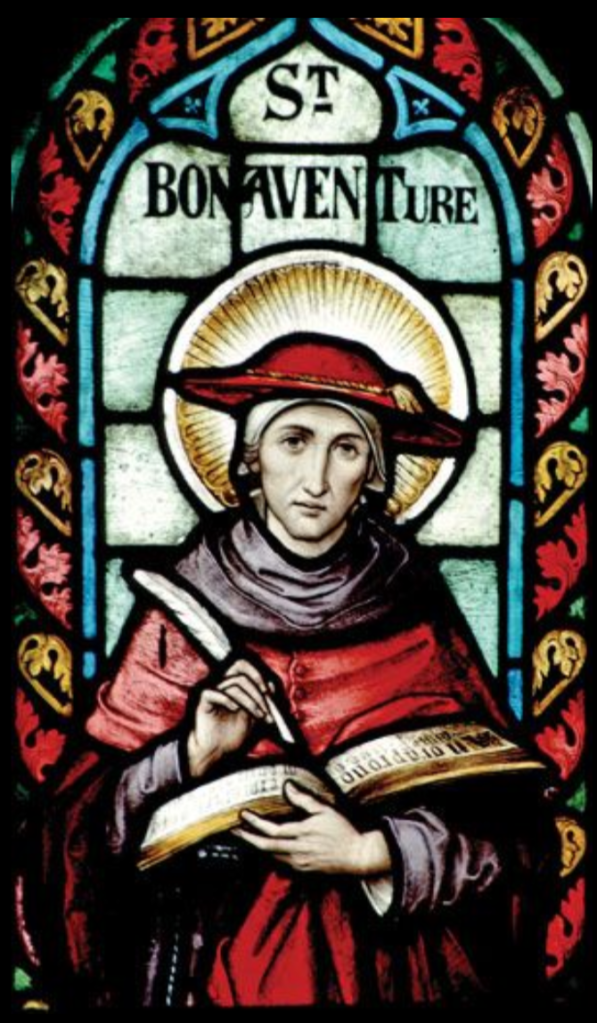
St. Bonaventure was born in 1221 in Tuscany, Italy, and was baptized John. Bonaventure joined the Franciscan Order, which was still new. In fact, St. Francis of Assisi, who started the Franciscans, was still alive when Bonaventure was born. As a young Franciscan, Bonaventure left his own country to study at the University of Paris in France. He became a wonderful writer about the things of God. He loved God so much that people began to call him the “Seraphic Doctor.” Seraphic means angelic.

One of Bonaventure’s famous friends was St. Thomas Aquinas. His feast day is January 28. Thomas asked Bonaventure where he got the ideas for all the beautiful things he wrote. St. Bonaventure took his friend and led him to his desk. He pointed to the large crucifix that always stood on his desk. “It is he who tells me everything. He is my only Teacher.” Another time, when he was writing the life of St. Francis of Assisi, Bonaventure was so full of fervor that St. Thomas exclaimed: “Let us leave a saint to write about a saint.” Bonaventure always kept himself humble even though his books made him famous.

In 1265, Pope Clement IV wanted Bonaventure to become an archbishop. He begged the pope to accept his refusal. The pope respected his decision. However, Bonaventure did agree to be minister general of his Order. He fulfilled this difficult task for seventeen years. In 1273, Blessed Pope Gregory X made Bonaventure a cardinal. The pope sent two papal messengers, who found Bonaventure working at the large washtubs. He was taking his turn scrubbing the pots and pans. The papal messengers waited patiently until Bonaventure finished the last pot. He rinsed and dried his hands. Then they solemnly presented him the large red hat that symbolized his new office.

Cardinal Bonaventure was a great help to this pope, who called the Council of Lyons in 1274. Thomas Aquinas died on his way to the Council, but Bonaventure made it. He was very influential at the assembly. Yet he, too, died rather suddenly on July 14, 1274, at the age of fifty-three. The pope was at his bedside when he died. Bonaventure was proclaimed a saint in 1482 by Pope Sixtus IV. In 1588, Pope Sixtus V declared him a Doctor of the Church.