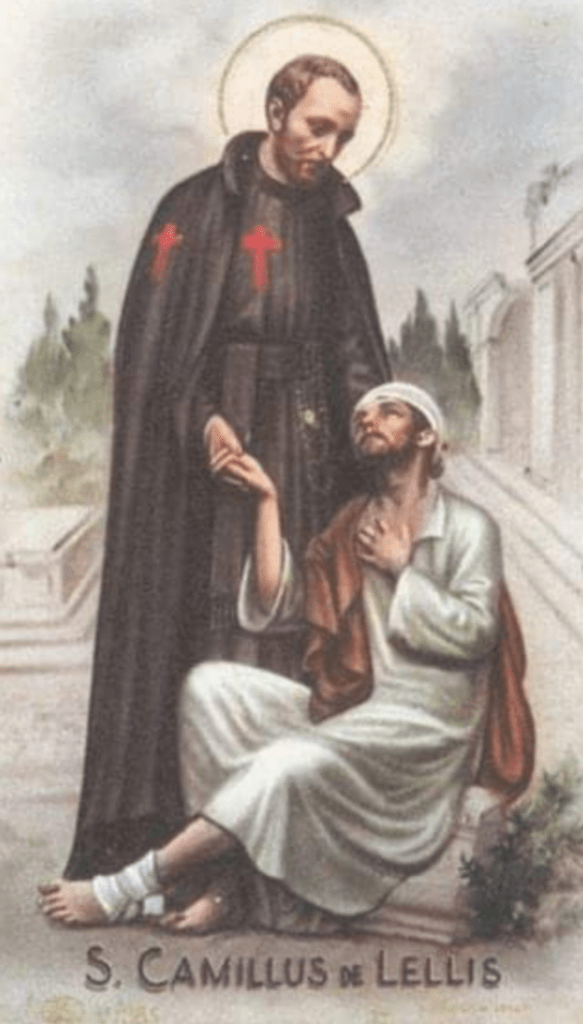
St. Camillus of Lellis – 14 July

He was born in Italy of a noble family. He became a soldier but his taste for gambling and riotous living eventually lost him everything. At the age of 25 he converted as the result of hearing a sermon. He twice tried to join the Capuchin friars but was rejected because of his poor health. Having had experience of hospitals from the inside, he determined to improve them, and he devoted the rest of his life to the care of the sick. He offered himself to the hospital of San Giacomo in Rome and eventually became its bursar. Hospitals were filthy, and staff were brutal and inadequate. He introduced many reforms and founded a congregation of priests and lay brothers, the Servants of the Sick (later known as the Camillians) to serve the sick both spiritually and physically. He was ordained priest in 1584. He resigned as head of his congregation in 1607 but continued to look after and visit the sick almost until the day of his death.

From a Life of St Camillus – Serving the Lord in his brethren

Let me start with holy charity, the root of all the virtues and the gift most characteristic of Camillus. He was so fired by this virtue, both towards God and towards his neighbours, especially the sick, that just to see them was enough to melt his tender heart and to make him forget every pleasure, every earthly delight and attachment. Indeed, even when ministering to just one sick man, he seemed to burn himself up and wear himself out with the utmost devotion and compassion. Gladly would he have taken upon himself all their sickness and sufferings to alleviate their pain or take away their weakness.
    So vividly did he picture and honour the person of Christ in them that often when distributing food to them he thought of them as his ‘Christs’, and would beg of them grace and the remission of sins. Hence he was as reverent before them as if he were really and truly in the presence of his Lord. Of nothing would he speak more frequently or fervently than of holy charity. He longed that it should take root in the heart of every man.
    To fire his brethren in religion with this fundamental virtue, he would impress on them these sweet words of Jesus Christ: ‘I was sick and you visited me.’ Indeed, so often did he repeat these words, he seemed to have them engraved on his heart.
    Camillus’ charity was so great and wide-ranging that he took to his kind and loving heart not only the sick and the dying but also all other poor and wretched people. His heart was so full of devotion for the needy that he used to say: ‘If ever there were no poor to be found on the face of the earth, people would have to search them out and even pluck them from below the earth in order to do good to them and show them mercy!’
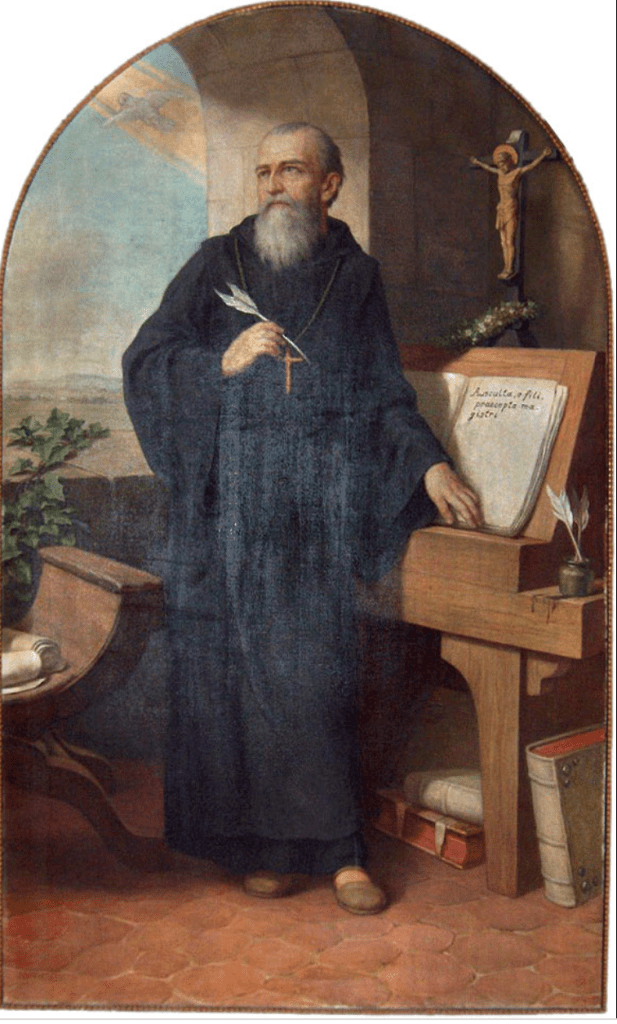
St. Benedict, Abbot, co-patron of Europe

St. Benedict was born in Nursia, Italy, in 480. He was from a rich family. His life was full of adventure and wonderful deeds. As a boy, he went to Rome to study in the public schools. As a young man, he became disgusted with the corrupt lifestyle of pagan Rome. Benedict left the city and went looking for a place where he could be alone with God. He found it in a cave in the mountain of Subiaco. A monk named Romanus taught Benedict about the life of a hermit and gave him a habit. He also brought Benedict some of his own food each day.

Benedict spent three years there alone. The devil often tempted him to go back to his rich home and easy life. However, Benedict overcame these temptations by prayer and penance. One day, the devil kept making him think of a beautiful woman he had once seen in Rome. The devil tried to make him go back to look for her. Benedict almost gave in to the temptation. But instead, he devoted himself even more to prayer and penance. From then on, his life was calm. He did not feel powerful temptations like that again.

After three years, people learned that Benedict was living in the mountain cave and started coming to him. They wanted to learn how to become holy. Some monks, whose abbot had died, asked him to be their new spiritual leader. But when he tried to make them do penance, they grew angry. It is said that they even tried to poison Benedict. He made the Sign of the Cross over the poisoned wine and the glass shattered to pieces.

Benedict left those monks and returned to his cave. From there he started twelve monasteries. Then he went to Monte Cassino where he built his best-known monastery. It was here that Benedict wrote the wonderful Rule for the Benedictine Order. He taught his monks to pray and work hard. He taught them especially to be humble always. Benedict and his monks greatly helped the people of their times. They taught them how to read and write, how to farm, and how to work at different trades. St. Benedict was able to do good because he prayed all the time. He died on March 21, 547. In 1966, Pope Paul VI proclaimed him the patron of Europe.

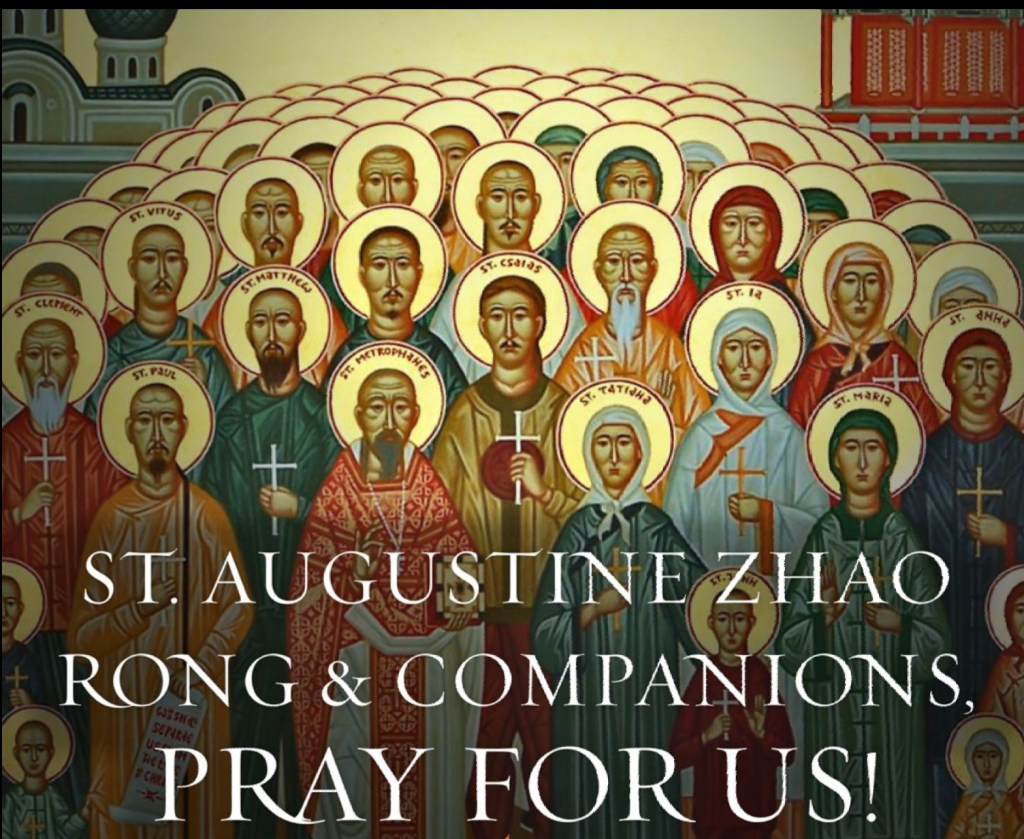
St. Augustine Zhao Rong and Companions – 9 July

On this day, the Church celebrates the many people throughout Chinese history who have been heroic examples of Christian faith. St. Augustine Zhao Rong is one of the 122 Catholics who died for their faith as martyrs between 1648 and 1930.

In 1815, a bishop named John Gabriel Dufresse was arrested. It was against the law to practice Christianity. One of the Chinese soldiers who was guarding him was deeply impressed by the bishop’s calmness and patience under persecution. After Bishop Dufresse was put to death, the soldier asked to become a member of the Catholic Church. He was baptized, taking the name Augustine. Augustine then entered the seminary and studied to become a priest.

Soon after he was ordained, he was arrested for being a Christian. He was tortured in an attempt to try to make him give up his faith in Christ. But his sufferings only made him stronger and surer of his beliefs. He was put to death, and his name was added to the list of brave Chinese men, women, and children who sacrificed their lives in testimony to their faith.

This list of heroes includes seventy-six lay people, some of them children as young as seven years old, eight seminarians, twenty-four priests, and six bishops. Of these people, eighty-eight were Chinese and thirty-four were missionaries from other countries, who had made China their home.

They were proclaimed saints by Pope John Paul II on October 1, 2000.

St. Maria Goretti – 6 July

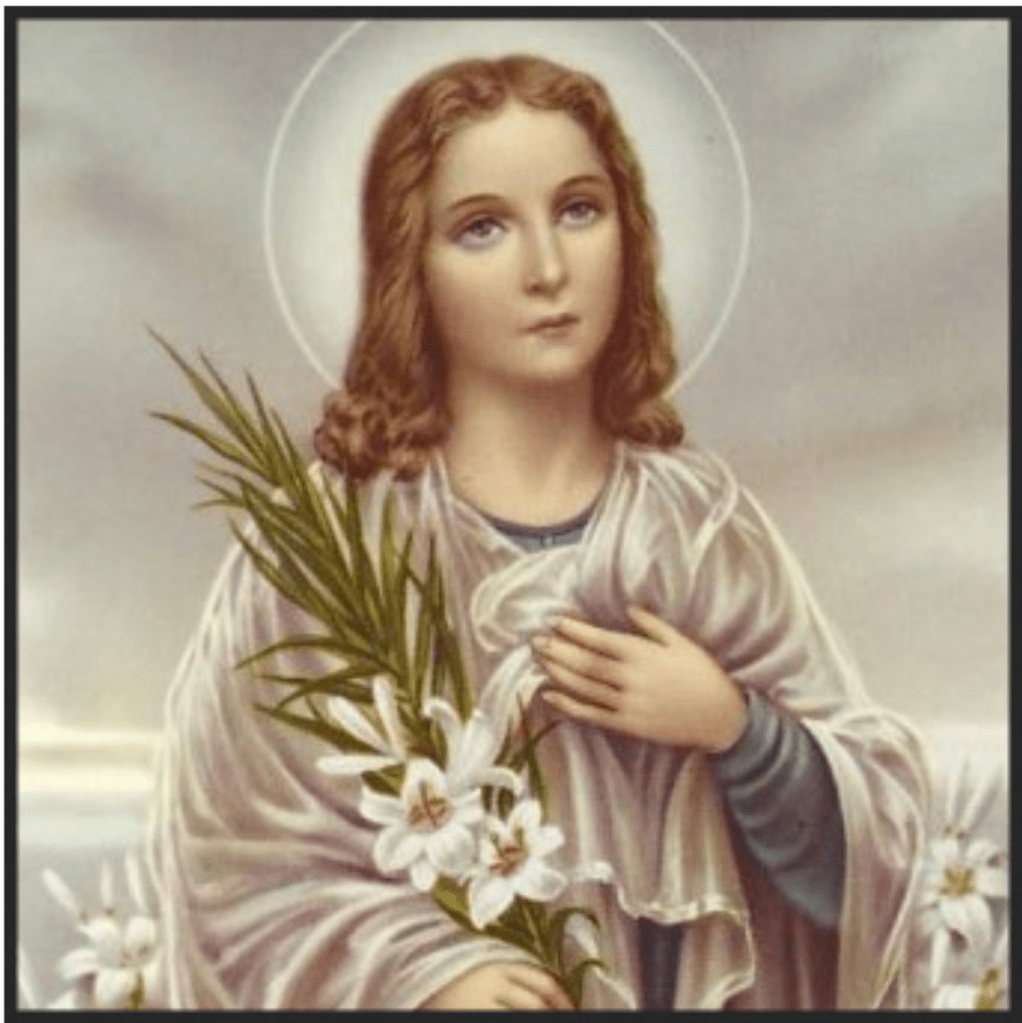
Maria was born in 1890 in Italy. Her father died of malaria ten years later. By the time she was twelve, Maria helped her mother on the farm, in the house, and with the care of the other children. She never complained because they were so poor. In fact, she cheered up her mother and was a great comfort to her. She went to Mass regularly even though it meant a two-hour walk. Maria also received the Sacrament of Reconciliation as often as she could.

A young neighbor, Alexander, tried a few times to make Maria sin against purity. She absolutely refused. She did her best to avoid him. July 5, 1902 was a hot summer day. Maria was alone in the cottage mending clothes. Alexander came again to try to make her sin. Maria refused once more. He attacked her and dragged her into an inner room. Maria managed to keep saying, “No, no! What you are doing is a mortal sin. God doesn’t want it. If you do this, you will go to hell.” And she struggled as much as she could. Alexander panicked. He stabbed her furiously with a dagger he had made. Then he ran away.

Maria was taken to a hospital, where she died about twenty-four hours later. During her last hours, she forgave her attacker. Her only worry was for her mother. With great joy, the girl received Jesus in Holy Communion. Then she went to heaven. Alexander was sent to prison. For eight years he refused to repent of his horrible crime. Then one night he had a dream or a vision of Maria offering him flowers. From that moment on, he was a changed man. When he was freed from prison after twenty years, his first visit was to the Goretti home. He asked Maria’s mother for forgiveness. Then Alexander spent the rest of his life as the gardener in a nearby monastery.

Maria was declared a blessed by Pope Pius XII on April 27, 1947. The pope appeared on the balcony of St. Peter’s with Maria’s eighty-two-year-old mother, Assunta. Three years later, on July 25, 1950, the same pope declared Maria a saint. He called her “a martyr of holy purity.”

St. Thomas Apostle – 3 July

St. Thomas was one of the twelve apostles of Jesus. In the Syriac language his name means “twin.” Once when Jesus was going to face the danger of being killed, the other apostles tried to keep the Master back. St. Thomas said to them, “Let us also go, that we may die with him” (Jn 11:16).

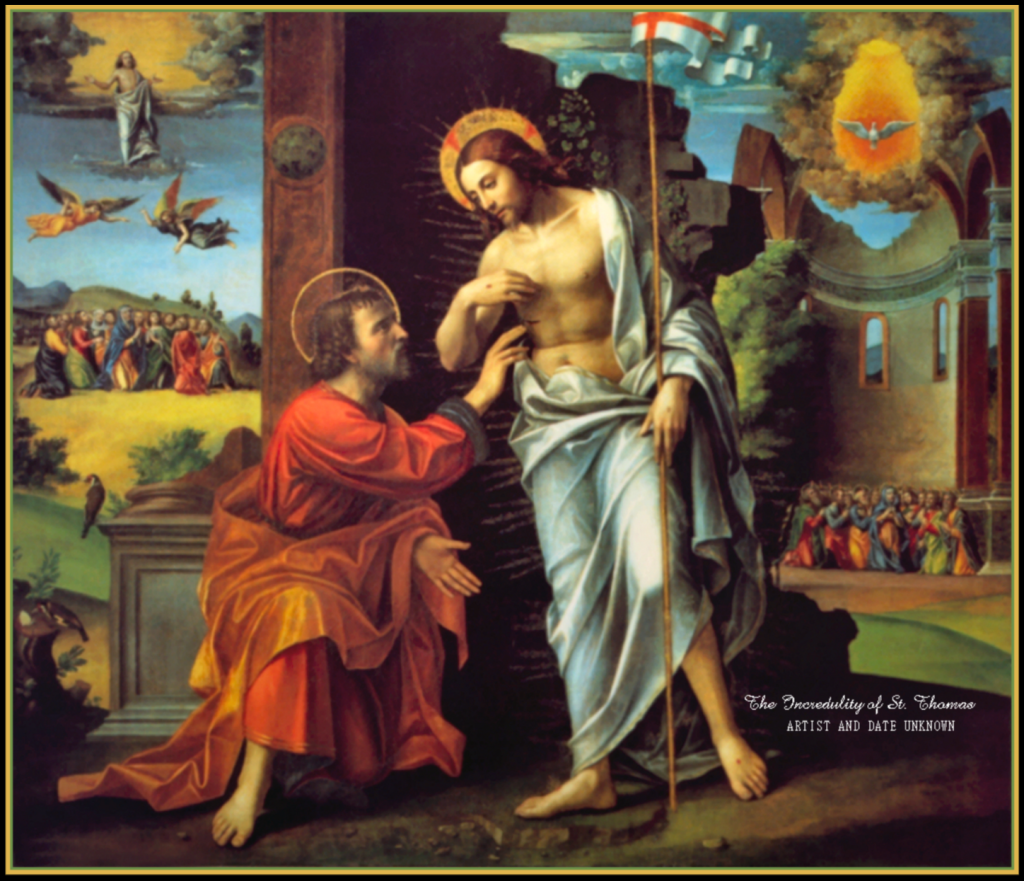
When Jesus was captured by his enemies, Thomas lost his courage. He ran away with the other apostles. His heart was broken with sorrow at the death of his beloved Lord. Then on Easter Sunday, Jesus appeared to his apostles after he had risen from the dead. He showed them the wounds in his hands and side. Thomas was not with them at the time. As soon as he arrived, the other apostles told him joyfully, “We have seen the Lord.” They thought Thomas would be happy. Instead, he did not believe their message. He hadn’t seen Jesus as they had.

“Unless I see in his hands the print of the nails,” he said, “and put my finger into the nailmarks, and put my hand into his side, I will not believe.” Eight days later, Jesus appeared to his apostles again. This time, Thomas was there, too. Christ called him and told him to touch his hands and the wound in his side. Thomas fell down at the Master’s feet and cried out, “My Lord and my God!” Then Jesus said, “Because you have seen me, Thomas, you have believed. Blessed are they who have not seen, and yet have believed.” You will find this story in the Gospel of John, chapter 20, verses 24–29.

After Pentecost, Thomas was strong and firm in his belief and trust in Jesus. It is said that he went to India to preach the Gospel. He died a martyr there, after proclaiming the Good News of Jesus to many people.

St. Oliver Plunkett (1625-1681)

Oliver Plunkett was born in County Meath in 1625, and died at Tyburn in 1681. Little is known about his early life except that he was educated privately by a Cistercian cousin, Dr Patrick Plunkett, who eventually became bishop of Meath. Ordained in Rome in 1654, he was professor at the college of Propaganda Fidei until 1669, when he was appointed archbishop of Armagh and Primate of all Ireland. He held synods and visitations and promoted the reforms initiated by the Council of Trent. It was a time when persecution was less severe, though he would often have to dress as a layman. In 1673 the English Parliament forced the king, Charles II, to behave more strictly towards Catholics, and edicts were issued banning bishops and all religious from Ireland. For the next few years he was able to continue his work clandestinely and was even able to hold a provincial synod. Despite the danger he went to visit his uncle, Bishop Plunkett, who was dying. He was arrested and imprisoned in Dublin Castle in 1679, he was tried on the extraordinary charge of having planned to bring seventy thousand French troops into Ireland. There was clearly no hope of a successful conviction in Ireland he was taken to London and duly found guilty of the charge. He was executed in London, the final victim of the ‘Popish Plot’ and the last person to be executed for the faith in England. He is remembered for his pastoral zeal and for the friendly relations he established with those who did not share the Catholic faith. His body rests at Downside Abbey, his head at Drogheda.

Feast day of Saint Peter and Saint Paul – 28 June

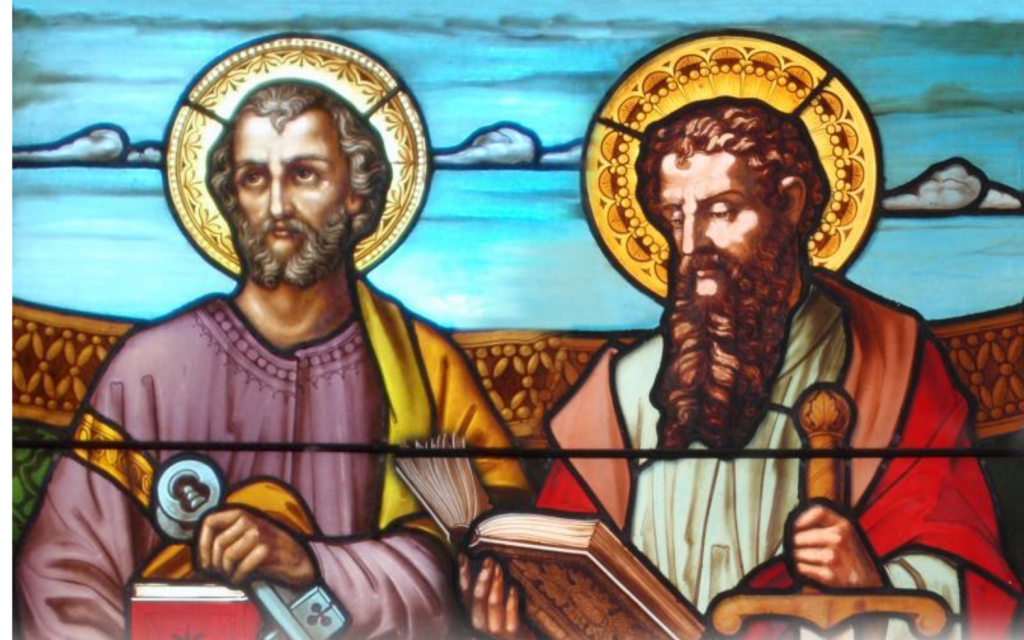
Peter, the first bishop of Rome (we now call the bishop of Rome the pope), was a fisherman from Bethsaida. Jesus invited him to follow him, saying: “I will make you a fisher of people.” Peter was a simple, hard-working man. He was generous, honest and very attached to Jesus.

This great apostle’s original name was Simon, but Jesus changed it to Peter, which means “rock.” “You are Peter,” Jesus said, “and on this rock I will build my Church.” Peter was the leader of the apostles.

When Jesus was arrested, Peter became afraid. That’s when he denied that he knew Jesus three times. But Peter was very sorry for what he had done, and Jesus forgave him. After his resurrection Jesus asked Peter three times, “Do you love me?” “Lord,” Peter answered, “you know all things. You know that I love you.” Peter was right. Jesus really did know! Jesus said kindly, “Feed my lambs. Feed my sheep.” Jesus was telling Peter to take care of his Church because he would be ascending into heaven. Jesus made Peter the leader of his followers.

Peter eventually went to live in Rome. Rome was the center of the whole world at that time. Peter converted many nonbelievers there. When the fierce persecution of Christians began, they begged Peter to leave Rome and save himself. There is a tradition that says Peter actually started to run away. But he met Jesus on the road. “Lord, where are you going?” Peter asked him. Jesus answered, “I am going to Rome to be crucified a second time.” Then Peter turned around and went back. He realized that this vision meant that he was to suffer and die for Jesus. Soon after, he was taken prisoner and condemned to death. Because he was not a Roman citizen, he, like Jesus, could be crucified. This time he did not deny the Lord. This time he was ready to die for him. Peter asked to be crucified with his head downward since he was not worthy to suffer as Jesus had. The Roman soldiers did not find this unusual because slaves were frequently crucified in the same manner.

St. Peter was martyred and buried on Vatican Hill. It was around the year 67. Emperor Constantine built a large church over that holy spot in the fourth century. Today the beautiful church called St. Peter’s Basilica stands there.

St. Peter has another feast that we celebrate. It is on February 22 and is called the Chair of St. Peter.

St Paul – Saul was Jewish, but because he was born in Tarsus, he was also a Roman citizen, with the Roman name “Paul.” He studied his Jewish faith carefully and was very dedicated to it. Saul made his living as a tentmaker.

Before Saul’s conversion, he thought he was pleasing God by persecuting the Christians. At the time of his conversion, Jesus had said: “I will show him how much he must suffer for me.” After Jesus appeared to Saul, Saul began to use his Roman name Paul. Paul loved Jesus very much, so much, in fact, that he tried to imitate him in every way. All his life, during his many missionary trips, Paul met troubles and went through dangers of every kind. He was whipped, stoned, shipwrecked, and lost at sea. Many, many times he was hungry, thirsty and cold. But Paul always trusted in God. And he never stopped preaching. “The love of Jesus presses me onward,” he said. In reward, God gave him great comfort and joy in spite of every suffering.

We read about St. Paul’s marvelous adventures for Jesus in St. Luke’s Acts of the Apostles, beginning with chapter nine. But St. Luke’s story ends when Paul arrives in Rome. He is under house arrest, waiting to be tried by Emperor Nero. A famous early Christian writer, Tertullian, tells us that Paul was freed after his first trial. But then he was put in prison again. This time he was sentenced to death. He died around the year 67, during Nero’s terrible persecution of the Christians.

Paul called himself the apostle of the Gentiles because he preached the Gospel to the people who weren’t Jewish. That took him across the then-known world. Because of Paul, we too, have received the Christian faith. In the New Testament, we can read many of the letters which he wrote to the churches which he helped form. In these letters, St. Paul gives helpful advice on living the Christian life.

We celebrate another feast of St. Paul, the feast of his conversion, on January 25.

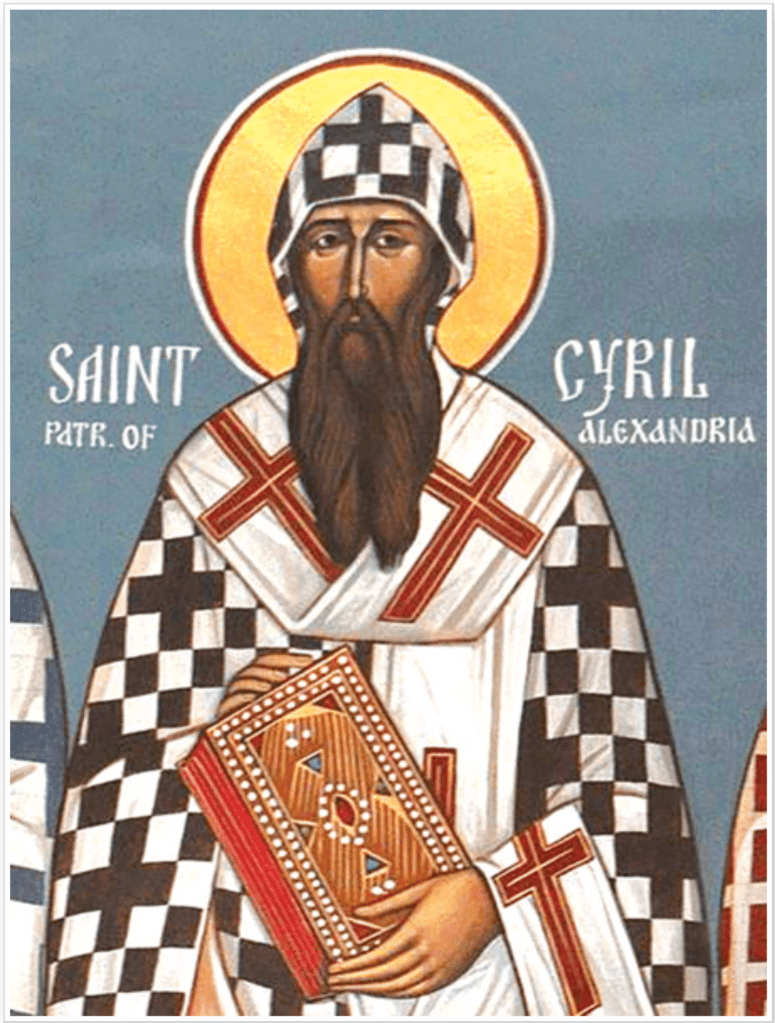
St. Cyril of Alexandria – 27 June

Cyril was born in Alexandria, Egypt, around the year 370. His uncle, Theophilus, was the patriarch or archbishop. His uncle meant well, but he had a bad temper and could be stubborn at times. Archbishop Theophilus was responsible for sending Bishop John Chrysostom (who became a saint) into exile in 403. But the emperor brought the famous bishop back to his archdiocese of Constantinople. It seems that Cyril was influenced by his uncle’s prejudice of John, and agreed when Bishop John was sent into exile. (We celebrate the feast of St. John Chrysostom on September 13.)

When Theophilus died in 412, Cyril became the archbishop. He was very clear about his love for the Church and for Jesus. He was a brave man in confusing times, and he preached what the Church taught. Cyril was honest and straightforward. He was not looking for praise or positions. However, Cyril could be impulsive and stubborn at times. He wanted to express the truths of the Church with his preaching and writing, and he did. But when he became upset, he was not concerned about saying things in a gentle way, so he blurted out angrily at times.

This must have caused him sorrow. Yet Christians were grateful for his many wonderful qualities, such as courage in defending the Church and her teachings.

Cyril was the representative of Pope St. Celestine I at the Council of Ephesus in 431. This was an official Church meeting of over 200 bishops. They had to study the teachings of a priest named Nestorius. The Council explained clearly that Nestorius was wrong about some important truths we believe. For example, he was teaching that Jesus Christ was God, but not man. Of course, Jesus is truly God and truly man. The pope gave Nestorius ten days to promise that he would not keep preaching his errors. But Nestorius would not give in. The Council explained to the people of God that such errors about Jesus could not be accepted. The bishops were so clear in their explanation that these false teachings would never again be a major threat.

The people were very grateful to Cyril of Alexandria who led the Council meetings. Cyril went back to his archdiocese and worked hard for the Church, writing and explaining the truths of the faith until he died in 444. Pope Leo XIII proclaimed St. Cyril a Doctor of the Church in 1882.