Homily – Matthew 28:8-15

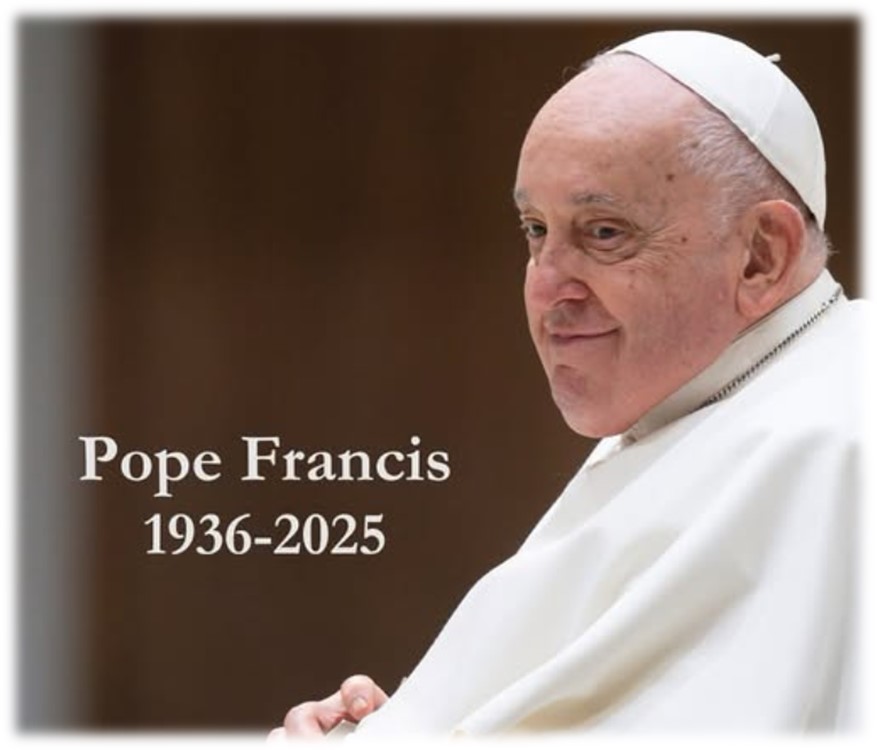
Death of Pope Francis – 21st April 2025 at 07:35am

In the Gospel passage the women were ‘apostles to the apostles’, the two Mary’s were the first to bear the message of the Resurrection to others.  They raced back to tell the eleven that Jesus had been raised to life again, and to meet him in Galilee.  There the eleven will see him with their own eyes and become witnesses of the most amazing occurrence in Salvation history. 

Without a moment’s delay the two Mary’s speed off to deliver the Good News, with hearts full of fear and joy at the same time. 

An interesting description is Jesus’ use of the word ‘brothers’ – ‘go and tell my brothers to go to Galilee’.  For it hints that Christ had forgiven his closest friends for abandoning him, and Peter from denying him three times.  The disciples are still called to form the spiritual family of Jesus’ brothers and sisters here on earth. 

Like the women in the Gospel, today we are also with mixed emotions.  On one hand we are joyful at the Lord’s Resurrection this Easter season, on the other, our Holy Father Pope Francis has passed away, during the early hours of this morning.

We thank the Lord of his life of discipleship, as a Jesuit Priest, Bishop and successor to St Peter.  With his firm resolve has helped broaden the opportunities for dialogue within and outside of the Church, he indeed was a true and faithful witness to the risen Lord.

Let us spend a moment of silent prayer for Pope Francis, and thank the Lord for his great witness to His One Holy and Apostolic Church.

Eternal rest grant unto him O Lord, and let perpetual light shine upon him, may he rest in peace. May his soul and the souls of all the faithful departed, through the mercy of God, rest in peace. Amen.

Statement from the Catholic Diocese of Lancaster upon the death of our Holy Father Pope Francis.

It is with great sadness that we learned this morning of the death of our Holy Father, Pope Francis, following a period of ill-health. Yesterday, on Easter Sunday, Pope Francis made a brief appearance at St Peter’s Square to bless thousands of people gathered in Rome to celebrate the Resurrection of the Lord.

May he now rest in the peace of the Risen Christ whose faithful servant he has been.

We are deeply grateful for the life and service of Pope Francis. While we mourn his loss, we are thankful for his steadfast witness and legacy.

His life of discipleship, and then leadership, within the Church saw him accept responsibility from the Lord as a Jesuit, a priest, a bishop, and finally as successor to St Peter. His firm resolve and challenging teaching on issues including care for creation, the sexual abuse of children, and insights into intimacy of human relationships, saw the Pope broaden opportunities for dialogue within the Church, and with people and groups from outside of the Catholic Church.

Masses for the repose of the Pope’s soul will be offered across the churches of our Diocese in the coming days. We entrust Pope Francis to the Father of all mercies and pray for the happy repose of his soul.

Please remember Pope Francis in your prayers.

On Monday 21st April 2025 at 6.30pm Evening Prayer for the Dead will be recited in the Saint Peter’s Cathedral, Lancaster, followed by a Requiem Mass at 7.00pm to which all are invited. Following this, the cathedral bell ringers will ring a quarter peal muffled.

A Diocesan Mass at the Cathedral, to which ecumenical and civic guests will be invited, will be on Monday 28th April at 7pm.

Homily – John 20:1-9

The disciples saw and they believed.  Yes, indeed!  Christ has truly risen.  This is our core profession of faith.  This this the cry of victory that unites us all here today.  Jesus is alive, and therefore who can ever be able to separate us from the Lord?  We will never be deprived of the divine love that conquered hatred and overcame death.  The Easter proclamation spreads throughout the world today, with joyful song of ‘Alleluia, Alleluia’.  The word that has remained silent all these days during Lent.  Let us now sing it with our voices, and above all, with our hearts and lives.  Jesus is our hope, He is the true peace of the world.

Reflecting on this Gospel passage, it brings back memories from various Passion movies that I have watched over the years on TV.  At the end of these movies, the film director seems to get the actor playing Christ to rise from the darkness of the tomb into the bright sunlight that shines all-round him, even rays of light beaming through the holes in his hands.  At that moment I say to myself, ‘Yes, He’s back’.

In the Gospel we heard, Mary of Magdalene came to the tomb early on the first day of the week.  Her only thoughts were to see Jesus’ body.  She might have wanted to complete any outstanding tasks on his body, since Jesus’ burial was done in haste, due to the Jewish feast of Passover. 

A time where no work was allowed to be done by law.  Mary’s sole desire was to spend time with Jesus.  I wonder what Mary might have been pondering in her mind, on her journey to the tomb, what was she thinking about?  It sounded like she had a restless sleep, as she was up so early in the morning.  Very eager to get to the tomb, without any thought about how she was going to move the big boulder away from the entrance.  Mary’s sole purpose was to be with the Lord. 

To her surprise the boulder was already moved and without looking inside she immediately knew the body was not there and then she ran to tell the disciples.

Up until that moment the disciples failed to understand the teaching of scripture, that Christ must rise from the dead.  In the months ahead they would recognise more and more the power of His Resurrection at work in their lives, calling them to live in an entirely new way. 

In a similar fashion, we are also filled with Easter hope as we celebrate and proclaim that Jesus Christ is risen, because what happened on that first day of Easter, has implications for us too.  The Resurrection is the central mystery of our redemption.  Christ’s victory breaks all the chains of our sin that we have made for ourselves.

The newness of life is the key message of this Easter season.  It comes about at the start of spring when nature begins to burst forth anew.

In Jesus’ Resurrection, God has had the final word.  Jesus’ life ends in victory and not in defeat.  The doors of Heaven are unlocked for our Salvation. 

We now know, that we have a heavenly home to look forward to, a new vision to focus upon, and eternal truths to shape our way of thinking.  This allows us to take a fresh look life, that we vowed to lead through our Baptismal promises.  During this Holy Easter Season, let the Resurrection account, dwell deeply within our hearts, as we rejoice and praise His Holy Name. 

We are an Easter people and ‘Alleluia’ is our song.

Homily – John 18:1-9,42

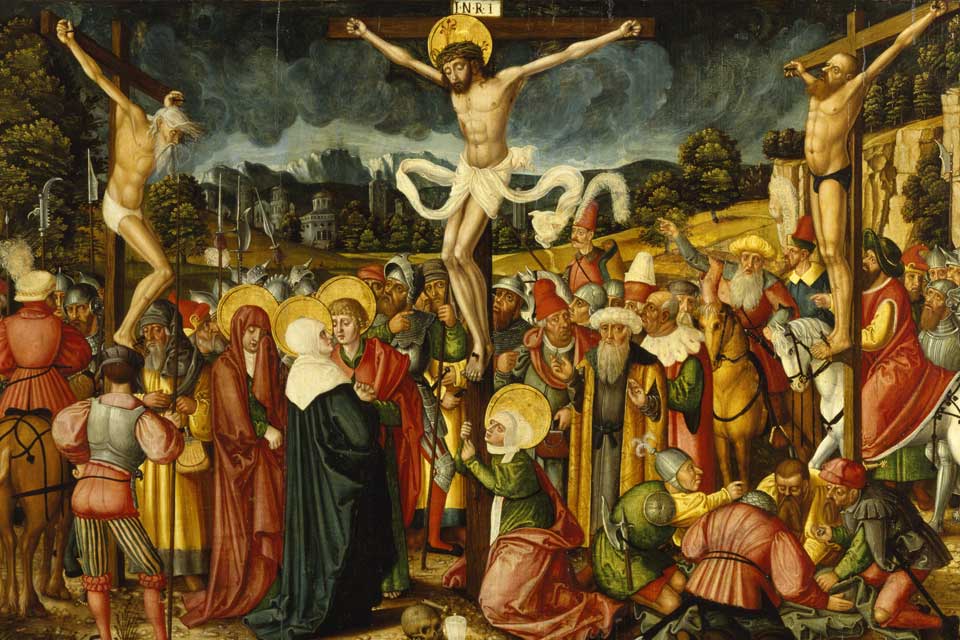
‘The Hour begins.’  Crucifixion was recognised as the lowest point of human humiliation in the Roman empire.  However, Jesus accepted His Cross for the salvation of the world.  His ‘hour’ had come.  The saving power on the Cross was His finest ‘hour’ that opened the doors to paradise.  He was the Lamb, that was led to its slaughter, and who took away the sins of the world. 

St John the Evangelist clearly highlights the ‘Kingship’ of Jesus within the Gospel.  We also see clearly, it is Jesus, the Sovereign Lord, who is in total control over all the events in His Passion.  He possesses the Divine Power, and these events would only happen because He allowed them to happen. 

Through His Kingship we see the freedom with which he goes to the Cross.  We hear in scripture: “No one takes my life from me, but I lay it down on my own.  I have power to lay it down, and power to take it up again.”  By freely going to the Cross, Jesus offers His life as a perfect gift of love, given to the Father for the world’s salvation.  Through His obedience, Jesus reveals the infinite depths of the Father’s love and mercy towards us, since we are sinners. 

I would like to focus on three specific elements of interest within the Passion narrative.  The Title on the Cross, the division of Jesus’ garments and the piercing of Jesus’ side.

According to Roman custom a board was carried in front of the condemned person or sometimes it was nailed to the cross itself.  Jesus’ board read.  ‘Jesus of Nazareth, the King of the Jews.’ 

It was Pilate who was responsible and took the initiative on writing these words down, making Pilate declare Jesus’ royal status to the whole world.  The Title board was written in Hebrew, Latin and Greek, the three great nation languages in the Roman empire.  So, it is interesting that the greatest nation in the world, should claim Jesus, King.

However, there might be a special hidden meaning that we are missing?  Since many of the Jews were there at the place of crucifixion, near the city walls, everybody had the chance of reading the Title board and to understand it.  Scholars have wondered, was God giving everyone a last chance, to understand Jesus’ offer of salvation, as King of the Jews?

The division of Jesus’ garments and the seamless tunic.  St John the evangelist goes into great detail on the sharing of Jesus’ garments.  Every Jew wore five items of clothing, however, there were only four soldiers.  The main item was a long under garment which was worn next to the body.  Described as being without seam and woven from top to bottom.  In the book of Exodus and Leviticus it says that this type of seamless garment was only worn by the high priests.  So, John the Evangelist was pointing to Jesus not only as King but also as eternal High Priest of the Church.

The Piercing of Jesus’ side.  This is unique to John’s Passion Narrative.  One of the soldiers thrust a lance into Jesus’ side.  In doing so a twofold prophecy was fulfilled.  The ‘Passover Lamb’ in Exodus: ‘None of his bones shall be broken’ and the ‘Pierced Messiah’ in Zechariah ‘They will look on the one whom they have pierced’. 

With Water & Blood being signs of the Sacraments of Baptism and the Eucharist.  There is also another important symbol here, that points to Jesus being the ‘New Temple’.  During the 1st century AD when Jews approached the temple mount at the time of Passover, when the sacrifices were being offered around 3pm, they would see a stream of blood and water flowing out from the side of the temple mount and down into the Kidron Valley.  This would have been a familiar image in the mindset of the 1st century Jew.  The Evangelist would have recognised the sign of Jesus’ body, when water and blood flowed from His side as the ‘New Temple of God.’  ‘Destroy this temple, and in three days I will raise it up.’  It is not the Temple in Jerusalem that will flow with blood sacrifices any longer, but it has been replaced with a new temple by the crucified body of Jesus. So, let us today, take to heart the true meaning of Jesus’ Passion and Death, it isn’t the time to be sad or down-hearted.  Since it was Jesus’ finest ‘hour’, His ultimate Glorification and Exaltation of the Son of Man, in order to save the world and bring us into Eternal Glory.

Homily – John 13:1-15

Jesus said, “I have given you an example, that you also should do just as I have done to you. ” 

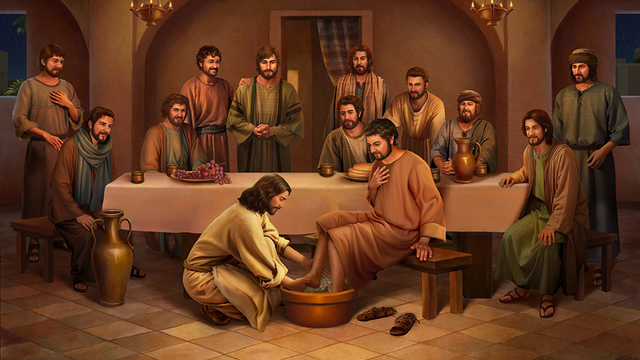
Jesus knew everything that was going to happen, he knew that his ‘hour’, his moment of Exaltation and Glorification was looming.  He is now surrounded by those whom he loved, his chosen friends and Apostles.

Jesus approaches his final moments by giving them his final teaching.  Jesus institutes the Eucharist, which is the source and summit of the life of the Church.  He also institutes the Ministry of the Sacred Priesthood to his Apostles, in a new and beautiful way. 

Jesus loves his own right up to the end.  He shows the intensity of his love, even to give up his life, but this love doesn’t stop at death.  Jesus who is aware that he is the Son of God, and that the Father has put everything into his hands, humbles himself to perform a final service.  A service that is more appropriate for the household servants.  Culturally, the underside of the foot was considered a dishonourable part of the body, and the washing of another person’s feet was performed by someone of a lower status. 

We are reminded of the hymn from the letter of St Paul to the Philippians:  “Christ, though he was in the form of God, did not count equality with God a thing to be grasped, but emptied himself, taking the form of a servant.

Christ came into the world, ‘not to be served but to serve’, this scene of the washing of the feet teaches us the same thing.  Through Jesus’ example we should serve each other in all humility and simplicity.  So, in the presence of his most beloved disciples, Jesus gladly carries out the task of a servant. 

We see on one hand the malice of Judas, who fails to respond to Jesus’ demonstration of love, and on the other hand we see the great emphasis of the goodness in Christ.  Jesus then reaches out beyond Judas’ malice by washing his feet and treating him as a friend, right up to the moment when he betrays him.

In our daily lives, you might find Jesus whispering in our ear from time to time, saying ‘I have given you an example of humility’, so that you too may learn to serve with a meekness of heart.   

Peter sees how inappropriate it was for Jesus to wash his feet, and starts to protest.  St Augustine comments by saying: ‘Who would not, shrink back in dismay, from having their feet washed by the Son of God.’  However, Our Lord’s loving gesture has a deeper significance than Peter was able to grasp.  It was only after the Resurrection that the Apostles understood the mystery of Jesus’ service.  By washing their feet, he was stating in a simple and symbolic way that he came to serve and that his service consisted of giving ‘his very life as a ransom for many.’  Jesus’ whole life was an example of service, fulfilling his Father’s will to the point of dying on the cross, to save all humanity from their sins, and allow them to enter into eternal life.  

Our Lord has promised us that if we imitate him, our teacher, we will find true happiness, that no one can take away. 

So, let us always reject from our hearts any pride or malice that we face, in order that, peace, love and joy will reign around us and within us, during this Holy Season of Easter. 

Homily – Luke 19:28-40

(Short Homily – due to long Passion Narrative during Mass)

We have finally begun the period of Holy Week, a day of glory and impending tragedy.  The scene is set for us, as Jesus makes his triumphal journey from Bethany to Jerusalem, his final movement to bring everything together through his death and glorious Passion.

Imagine the sight of Jesus riding into Jerusalem on a donkey with people waving palm branches and shouting, ‘Hosanna in the highest’, acclaiming him King, must have made the visiting crowds who were gathered for the Passover festival, stop in amazement.  Little did the people know that the rejoicing would quickly be swept aside.  Before long, the triumphal shouting turned to tragedy, those palm branches changing into the wood of the cross, the hosannas, became jeers and calls for his death.

This Holy Week is a most sacred time, it highlights the peak moments of Christ’s love for us, gives us an opportunity to look at our lives and accept responsibility for our failings.  Jesus was betrayed by Judas, denied by Peter and abandoned by all.  If we are honest with ourselves, we can see shades in our hearts, that shadow, those who put Jesus to death.  Peter and Judas, Pilate and the soldiers.  This should cause us to reflect on our own sins and failings inside each one of us. 

Every Christian becomes aware that in their own life they need to meet the same fate as Jesus.  We should join in Christ’s suffering and death, in order to share his eternal glory.  Our victory, like Christ’s, comes only through the cross. 

Let us during these final days of Lent offer ourselves the opportunity to harmonise our minds and hearts with Christ, allowing the truth of Jesus’ ultimate, finest ‘Hour’ of Exultation and Glorification to dawn deeply in our hearts. 

The truth is that:  “For God so loved the world that he gave his only Son, so that everyone who believes in him may not perish, but have eternal life.”

Bishop’s Pastoral Letter on the Terminally ill Adults (End of Life) Bill

Dear brothers and sisters in Christ,
I wish to speak with you today about the process in which our Parliament is currently considering legalising assisted suicide through the Terminally Ill Adults (End of Life) Bill. As I have made clear earlier in this debate, as Catholics we have maintained a principled objection to this change in law recognising that every human life is sacred, coming as a gift of God and bearing a God-given dignity. We are, therefore, clearly opposed to this Bill in principle, elevating, as it does, the autonomy of the individual above all other considerations.
The passage of the Bill through Parliament will lead to a vote in late April on whether it progresses further. This will be a crucial moment and I, together with all the Bishops of England and Wales, am writing to ask your support in urging your MP to vote against this Bill at that time.
There are serious reasons for doing so. At this point we wish not simply to restate our objections in principle, but to emphasise the deeply flawed process undergone in Parliament thus far. We wish to remind you that it is a fundamental duty of every MP to ensure that legislation is not imposed on our society which has not been properly scrutinised and which will bring about damaging consequences.
The Terminally Ill Adults (End of Life) Bill will fundamentally change many of the key relationships in our way of life: within the family, between doctor and patient, within the health service. Yet there has been no Royal Commission or independent inquiry ahead of its presentation. It is a Private Member’s Bill. The Bill itself is long and complex and was published just days before MPs voted on it, giving them inadequate time to consult or reflect upon it. The time for debate was minimal. The Committee examining the Bill took only three days of evidence: not all voices were heard, and it comprises an undue number of supporters of the Bill. In short, this is no way to legislate on such an important and morally complex issue.
One consequence of this flawed process is that many vital questions remain unanswered. Can MPs guarantee that the scope of the Bill will not be extended? In almost every country where assisted suicide has been introduced the current scope is wider than was originally intended. What role, if any, will the judiciary have in the process? We were told that judicial oversight was a necessary and vital part of the process; now we are told it isn’t needed at all. What will protect the vulnerable from coercion, or from feeling a burden on family? Can the National Health Service cope with assisted suicide or will it, as the Health Secretary has warned, cause cuts elsewhere in the NHS? Can MPs guarantee that no medical practitioner or care worker would be compelled to take part in assisted suicide? Would this mean the establishment of a ‘national death service’?
In contrast to the provisions of this Bill, what is needed is first-class, compassionate palliative care at the end of our lives. This is already provided to many in our society but, tragically, is in short supply and underfunded. No-one should be dispatched as a burden to others. Instead, a good society would prioritise care for the elderly, the vulnerable, and the weak. The lives of our families are richer for cherishing their presence.
It is sad reflection on Parliament’s priorities that the House of Commons spent far more time debating the ban on fox hunting than it is spending debating bringing in assisted suicide.
I am sure that you will share these concerns. It is now clear that this measure is being rushed without proper scrutiny and without fundamental questions surrounding safeguards being answered. This is a deeply flawed Bill with untold unintended consequences.
Every MP, and Government, has a solemn duty to prevent such legislation reaching the statute book. This, tragically, is what may happen. So I appeal to you: even if you have written before, please make contact now with your MP and ask them to vote against this Bill not only on grounds of principle but because of the failure of Parliament to approach this issue in an adequate and responsible manner.
In his Letter to the Philippians, from which we heard in the Second Reading, St Paul reflects on the difficulties and responsibilities of life. He speaks of ‘pressing on’ and ‘striving’ for the fulness of life promised in Christ Jesus. Yet he is totally confident in his struggles because, as he says, ‘Christ Jesus has made me his own’.
We too have many struggles. We too know that Christ Jesus has made us his own. So we too press on with this struggle, so important in our times.
May God bless you all.
Catholic Bishops’ Conference of England and Wales

Rt Rev Paul Swarbrick
Bishop of Lancaster

Homily – Luke 15:1-3, 11-32

You might think after hearing about the parable of the Prodigal Son in our Gospel reading, I’ll be talking about mercy and forgiveness.  Instead, I’ll be focusing on the message of joy and rejoicing.  A joy of a repentant son.  Especially the joy that God receives with all the angelic hosts, when a repentant sinner returns home. 

In the Gospel, Jesus had a reputation of being with tax collectors and sinners.  He calls them to repent, and many of them do change their ways.  They are the sick, the poor, the crippled, the blind and the lame, who are invited to the banquet meal, and Jesus eats with them joyfully.  However, the Pharisees and Scribes object to a fellowship with sinners.  They complain and grumble like the Israelites who spent 40 years roaming around the wilderness and were complaining and grumbling against God and Moses.

Jesus defends himself by speaking about the parable of the Prodigal Son.  Jesus gives the Pharisees and Scribes an opportunity to overcome their grumbling and to join in with the celebration.  Like the father inviting his elder son to come and celebrate the return of his brother.  The figure of the compassionate father reveals the mercy of God who desires all his children to come to his heavenly banquet. 

A Priests main role is to administer the Sacraments, which is a free gift that Jesus has given to His Church through His Death, Resurrection and Ascension into Heaven. 

The Sacrament of Reconciliation is such a wonderful and powerful gift.  Every time we leave the confessional box we should be jumping and shouting for joy.  Rejoicing that our sins have been wiped away, and our souls have returned to the same state of purity as from our own Baptism.  God has purified us with his merciful loving kindness, making us whiter than snow. 

Please use this wonderful free gift frequently, as it is one of the Sacraments of the Church.  God seeks out the sinner and calls us by name.  Let us respond faithfully and rejoice in this happiness with God and all his Angels and Saints who are celebrating in the Kingdom of Heaven.  

On this fourth Sunday of Lent, it is a day to stop and reflect on the joys of Easter, Jesus being the ‘Light of the World’, gaining ‘New Life’ with Him at His Resurrection.  Our Lenten colour of purple has been lightened with the Easter colour of White.  So, if we liturgically mix the two colours together, we get today’s colour of Rose. 

The only other day in the church’s calendar where we wear Rose is on the 3rd Sunday of Advent, because we are ‘Joyful’ once again, as we are nearing the big festive celebrations.

Jesus is our Salvation.  He is the source of our light and our hope.  He has made us beacons of His wonderful Divine light.  A light that has been entrusted to us to be kept burning brightly, setting an example for others to follow, as we lead good Christian lives.

This weekend, as we all know is Mothering Sunday.  A time for Mothers and Grandmothers to relax from their duties and to get pampered.  So, Fathers, Sons and Daughters, get your aprons on and prepare the evening meal, with a nice bottle of wine.  Mothers, may you enjoy the rest of the evening that still remains, with your feet up and a glass in hand.    

Today is definitely a day for rejoicing, because like our Mothers who have unconditional love for their children, Our Heavenly Father loves us unconditionally too, a love that lasts for eternity.

Homily – Luke 13:1-9

During this week, we have been very lucky with the weather, it’s been warm and sunny.  Spring is definitely here.  Signs of life from plants to trees, even to the young lambs running around in the fields.  When we see leaves beginning to sprout, we know summer fruit is near.

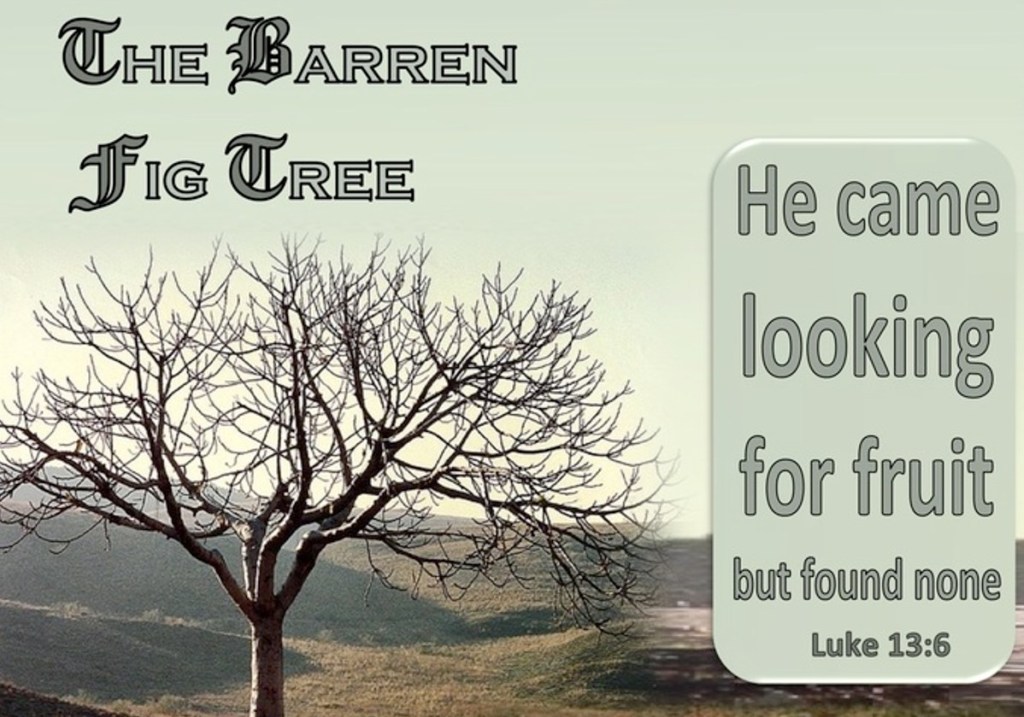
In the Gospel we hear the parable of the fig tree.  A theme talking about repentance.  Since we hear the people and leaders being urged to repent before they wither and die like the fig tree.  However, Jesus wants the fig tree to have one last chance, allowing the gardener to fertilise it, in hope of it bearing fruit in the future.  This parable shows us that there is still time available for a conversion of heart and saying sorry, asking for our sins to be forgiven through the Sacrament of Penance.  However, time is not endless, there will come a point when the patient gardener will say, that’s enough, I’ll have to cut you down. 

This happened with the Israelites, when they spent 40 years travelling the wilderness.  After they were freed from the Egyptians, they were heading to the Promise Land that God gave to Moses and the Jewish people, this was technically only a few weeks journey away.  However, it took them 40 years, because the Jewish people, lost sight of God’s love, they turned their backs on him, by moulding a Golden Calf to worship.  God said, that this generation will not enter the promise land, so they spent the next 40 years, waiting for that generation to die out in the desert. 

However, we know that God, is all loving, patient and kind.  A love that wills the good of the other, because that is what God is.  He doesn’t go in and out of love, he doesn’t change his mind, he doesn’t love some and not to others.  God indeed like the sun shines on the good and bad alike.  In the words of Jesus:  No act of ours can possibly make him stop loving us.  We are unique in God eyes, we are priceless, there is only one of us … (thank goodness), and we are made perfect, in the image and likeness of God.  Making God the best of parents.

However, we have also free will, a precious gift from God.  We are definitely not God’s puppets, we have the free will to say yes and no to anything we like, even to God’s love.  If we turn towards him in love and repentance, then we open like a flower, radiating God’s love and divine light in our inmost being.

However, time is running out, we do not know the time or the hour, when Jesus will call us by name to depart from this world, or when Jesus will descend on the clouds at his second coming.  The ‘End of the ages’, refers to the age that was opened by Jesus’ Resurrection, which is the final times. 

So, let us use the rest of our Lenten season to renew our Lenten promises, and to turn to him in love and mercy.  We may ask him to release us from the heavy burdens that we carry, because often the Lord does release the pressure from our minds, but all too often his answer is to give us the strength we need to endure the suffering and to turn it into a sacrifice, that is acceptable to the Lord for the service of others. 

St Paul says:  ‘I rejoice in my sufferings for your sake, and in my flesh I am filling up what is lacking in the afflictions of Christ, on behalf of his body, which is the Church.’ 

God does not allow us to be tempted beyond our strength, so when we are tempted, we should turn to God Our Father in prayer, with Mary and Jesus at our side.  Asking for his protection against the evil one, and we will be heard, and our prayers answered.  

Homily – Luke 9:28-36

In the first reading from Genesis, we hear the new covenant being made between God and Abraham, where his descendants will be as numerous as the stars in the night sky. 

Like Abraham we are also called to journey into the unknown, to test our limits, to go that extra mile, and to respond to God’s call at all times.  In our moments of crisis or when life is clouded with despair, it is important to keep on trusting in God, in his Word.  As Christians we walk by faith, since Jesus is the ‘Word of God’, and he is all mighty and powerful, he will always walk along side us. 

In the gospel, we hear the story of that amazing event in the Lord’s life of the Transfiguration.  I had the privilege to visit Mount Tabor, while on pilgrimage at Seminary college.  I had time to contemplated the bible scene in my head, which gave me an overwhelming and humbling experience.  We hear that the three apostles were also completely overwhelmed when they saw Christ, in all his Divine Glory.

This event came soon after the announcement from Jesus, about his coming Passion and Death.  This Transfiguration is the visible anticipation of what Jesus had revealed to the apostles about his Resurrection and future Glory.  For a brief moment, three of his closest apostles, had the privilege to see Jesus as he really is, human and divine, full of Power and Glory.  It was to establish beyond all doubt that Jesus was the Son of God. 

It was a blessing for these three Apostles, because it gave them the steadfastness of faith they needed, to accompany the Lord through the darkness of Jesus’ arrest at Gethsemane and the humiliation of his Passion and Death.

A cloud covered them and a voice from Heaven saying “This is my beloved Son.  Listen to him.” Clouds have a profound significance for the people of Israel, since it was the means by which God visibly manifested his presence during their wanderings in the desert.  The cloud symbolises the Mystery of God, and it is also a sign of the Holy Spirit, who overshadowed the Virgin Mary at the Annunciation, and dwells in the hearts of all believers.  At the Transfiguration the cloud reveals that God’s new and eternal dwelling place, where heaven and earth meet, is Jesus Christ himself.

For us today and during this Lenten season, we should not be spectators of this wonderful event of the Transfiguration, but like the apostles, we should be encouraged to climb the mountain and to reflect upon his message. 

It is only through his Passion and Death that Christ came to the Glory of his Resurrection.  If he is to transfigure our sinful bodies, to make them into copies of his own glorious body, then the road we should take, is also one of suffering, travelling with Christ, along our own pilgrimage journey here on earth. 

Lent provides us with an excellent opportunity, through prayer, fasting and almsgiving, to put our hearts in order.  It teaches us that the road to heaven is by the sweat of our brow, through our daily frustrations and disappointments.  However, by working through these problems we are able to meet people with kindness, with love and with compassion. 

May this season, help us to overcome our weakness’ and to grow in maturity, through God’s grace and patience.  Because nothing in this world, that is worthwhile or worth waiting for, is ever simple or straightforward. 

May we all grow brighter, the more we turn towards God, since we are created in his image and likeness, furthermore we are meant to reflect his Glory, through our Baptism, being beacons of God’s divine light, for the whole world to see.

Then one day, when we are finally called from this life, we may have the greatest of all privileges to see the Lord’s Glory, by seeing God, face to face, with all the Angels and Saints in his Heavenly Kingdom.

Homily – Luke 4:1-13

APPOINTED TO BE READ AT ALL PUBLIC MASSES IN ALL CHURCHES AND CHAPELS IN THE DIOCESE OF LANCASTER ON THE WEEKEND OF 8-9 March 2025

Pastoral Letter First Sunday of Lent 2025.

My dear people,

With the placing of the blessed ash on our foreheads we have begun once more the Holy Season of Lent, remembering that we are dust, and into dust we will one day return. We may be familiar with Lent, with its penances, its call to more heartfelt prayer and its call to share more generously with the poor, but this is a new Lent for us all. We are asked not merely to repeat what we have done before, but to go deeper into the life of Christ. The world has changed over these past twelve months, not all for the better, and we too have all grown older.

Let us take a moment to pray for our Holy Father, Pope Francis, as he continues to struggle with poor health and the frailty of his years. He still leads us. His example is a rich lesson in Christian discipleship.

Above all, it is Jesus Himself who claims our attention, it always is. As we see Him head off alone into the wild, inhospitable places, let us remember with humility that He does this for each of us. In a true sense, He takes each of us with Him. It is for our good that He does battle with the devil. He overcame His temptations out of hope that we would each come to realise not so much what He has done, but why He has done it.

Am I worth this? After all the good I have wasted, the indifference I have shown, the selfishness that has pervaded my life – and my prayers – am I worth this? His answer is, yes, you are.

What for me would be a successful Lent? Is it to simply keep my resolutions to do without something I enjoy, to spend more time in prayer, to ‘be nicer to others’? Surely what will count is not what I achieve in these disciplines – worthy though they are – but to comprehend a little more deeply why it is worth bothering.

There is much that is wrong in the world. I don’t need to go into any detail – you didn’t come to Mass to dwell on problems. You are already all too well aware of them. Nor do you need reminding that there is much wrong with each of us too. We have others to remind us of that fact!

We come to be reminded of Grace, of the love God has for even the most persistent, wayward of His children. We come to be reminded that there is more to us than we

know, and that the Good Lord has not lost sight of His little ones, nor has He lost Hope that we may yet reach with Him the place of safety, of true and lasting peace, in the arms of the loving Father. He will not allow the tempter to convince Him, or us, that we are a lost cause. But see what it cost Him.

In the wilderness He refused to perform miracles that might have made life easier for Himself, given Him just a little comfort (no one was watching, no one would know).

Later, after His return to society, He would perform miracles, but the purpose of all His miracles was not to solve people’s problems or even to relieve their misfortunes. The true purpose of each miracle was that people might know who He is, and to give them hope, that neither this life, nor their own achievements – so fleeting- could ever give.

I address you as people of Faith, as people who are open to receiving Grace. Imperfect as we are, in this Jubilee year, and also marking the Centenary of the Diocese, we are given new hope that God’s will may be done, even in us. We leave Him to be the judge of what is real success.

I reflect on how Mary must have been aware of what her son was doing when He seemed to turn His back on society. She understood as no one else could, and was inflicted with constant, daily reminders of Him by His very absence from the home He had until this moment, shared with her. Simeon’s words must have haunted each day as she remembered – ‘and a sword shall pierce your own soul too.’ This is the way of the cross, but can it also be the way to heaven?

May this Season of Lent refresh our Faith in a way that has not happened for us before. May we think first of what He has done for us, not what we can do for Him – that will follow in due course. May we be drawn to the beautiful Sacrament of penance where we meet the Lord in a kind of desolation, a true wilderness, and yet experience an enchanting intimacy with Jesus that changes the burden of stones into the taste of freshly baked bread!

There is a way of living our Faith that saps our strength. Jesus shows us another way, a way that feeds us and gives us strength. Let us set ourselves to follow His way, confident that it will lead us to Easter and the tomb, with the stone rolled away.

With my blessing,

+ Rt Rev Paul Swarbrick

Bishop of Lancaster