

2nd Sunday of Easter – Divine Mercy Sunday
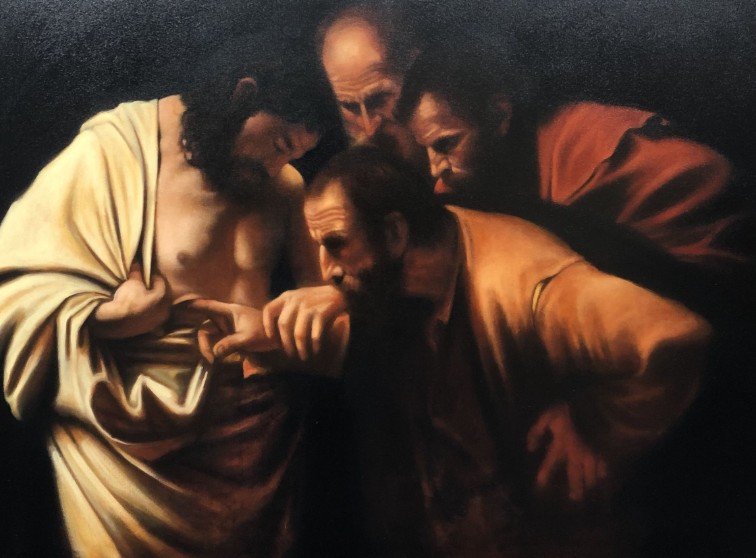
Jesus said to Thomas ‘Give me your hand, put it into my side, doubt no longer but believe.’ Today we hear the encounter between Jesus and Thomas, the doubting disciple. We shouldn’t dismiss Thomas as a man of little faith. Who could really blame him for not believing. After the events on Good Friday, Thomas had seen the Lord, whom he loved, die the death of a criminal, crucified between two thieves and witnessed Peter denying him three times, even after Peter promised loyalty towards Jesus hours earlier. Thomas was disheartened, disillusioned and angry, which made him have a harden heart and unwilling to accept the words of others, even about seeing the Risen Lord.
Today is Divine Mercy Sunday, a devotion that was permitted by St. Pope John Paul II after reinvestigating St Faustina’s visions. St Faustina was a Nun of the ‘Sisters of Our Lady of Mercy’. On the 22nd of February 1931, she had a vision from the Lord. Jesus appeared to her bringing a message of Mercy. She recalls in her diaries, that Jesus was dressed in white with His right hand raised in blessing, and the other hand touching his heart. Two large rays came forth from his heart, one red and one white. This image was painted and the words ‘Jesus, I trust in You’ were written below. In another vision Saint Faustina was told about the teaching of the Chaplet of Divine Mercy, praying for the conversion of sinners throughout the world.
But, let us return back to the image of Christ, especially the ‘side of Christ’, where Thomas placed his hand, and where St Faustina saw two rays of red and white light. What do we understanding of the importance of Jesus’ pierced side, what can it teach us? We know that it points to Jesus’ crucifixion when his side was pierced by the Roman Soldier, and Blood and Water gusted forth from his wounded heart. This is a reminder that life emerges from death, through the Sacraments of the Church. Blood and Water being Catholic symbols for the Sacraments of Baptism and the Eucharist.
The piercing of Jesus’ side is unique to John’s Gospel, and it fulfils a twofold prophecy. ‘None of his bones shall be broken, and they will look on the one whom they have pierced.’
There is symbol-ism here of Jesus being the New Temple. There is an ancient document called the Mishnah. This document explains that there were two drain holes at the south-western corner of the Altar in Jerusalem, this was to drain away all the blood from the sacrificed lambs. It would have come out of the side of the temple mount, mingled with water flowing down into a stream into the Kidron valley. For a first century Jew, it would have been a very familiar sight. John the evangelist would have recognised this parallel link to Jesus’ pierced side when blood and water gushed forth on the cross. Jesus’ body is now the New Temple. We hear in Jesus’ own words saying: ‘Destroy this temple, and in three days I will raise it up.’ The Jewish Temple mount has now been replaced with a New Temple, that is Jesus’ body, that comes forth the Sacraments of the Church.
We might have doubts in our faith from time to time, but searching for the truth is nothing to be ashamed from. It helps us grow stronger in our faith. In many ways Thomas echoes our moments of uncertainty. Our vision of God gets blurred by clouds of doubt. But it is only through the Risen Christ that we enter into a personal relationship with him, that allows us to enjoy the New Life which he offers.
When we have moments of despair and all else seems to fail. Fall back on your faith, say a prayer similar to: ‘Jesus I trust in you’, and He will help and support you in your time of need. ‘Doubt no longer, but believe.’

