

3rd Sunday of Easter
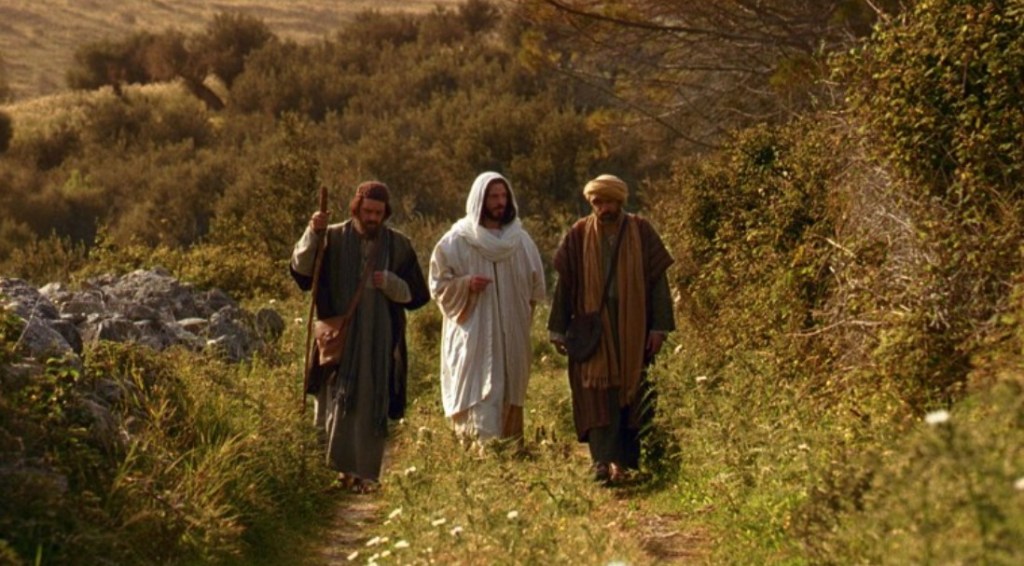
‘They recognised him at the breaking of bread.’ In the Emmaus story today, two disciples were going home, discussing the happenings of recent events, striving to make sense of their disappointment of Jesus’ crucifixion. A man they loved, and with his death, their whole world had collapsed, putting an end to their dreams for the redemption of Israel. Suddenly, a stranger appeared and joined them, who listened sympathetically to their story, he helped them to see through scripture the full meaning of what had happened. At every step of their troubled journey Jesus was at their side, but they did not recognise him until the breaking of bread at Emmaus.
Today we are shown an important pattern of the opening up of scripture followed by the breaking of bread. This pattern becomes so important to the early Church that it becomes the basic pattern of daily Mass for us. The Liturgy of the Word leading into the Liturgy of the Eucharist.
We feel the presence of Jesus, first by his Words and then again with the very act of the breaking of bread. This Emmaus account makes clear that Scripture itself points us towards an appreciation of its own unbreakable bond with the Eucharist. Both are so deeply bound together that we cannot understand one without the other. The ‘Word of God’ sacramentally takes flesh in the event of the Eucharist. And the Eucharist opens our understanding of the scriptures, illuminating our minds and hearts.
We heard the two disciples say to each other ‘didn’t our hearts burn within us as he talked to us on the road explaining the scriptures.’ Their ‘eyes were opened’. We hear the very same three words in Genesis, when Adam and Eve’s ‘eyes were opened’ after disobeying God, after eating of the forbidden fruit in the Garden.
St Leo the Great comments on this by saying: ‘the eyes of these two men were opened, far more happily to the sight of their own glorified humanity, rather than the eyes of our first parents, to the shame of their sinfulness.’
Jesus is once again presented as the ‘New Adam’ who here gives living food to the ‘first meal of the new creation’ at Emmaus.
This Gospel account helps to shed light on our own situation in our times of trial and distress. How many times have we walked the road to Emmaus with downcast faces, either by having quarrels at homes, difficulties at work, or the loneliness of being rejected. The troubles and worries of life can crowd our minds that we can lose sense of our direction and we are brought to the point of despair. All the time forgetting that Jesus is walking beside us, anxious to help, if only we would turn to him in prayer for guidance.
Since our ransom has been paid in the precious blood of Christ, let us reflect upon how many times the Lord has helped us in our daily lives.
We prayer to the Lord to continue to show us his love, by letting us see him more clearly by his divine presence. Through the Liturgy of the Mass, and especially in our own ‘path of life’ comprising of daily readings of scripture and of prayer.
We ask the Lord, that he will illuminate our minds and hearts on this great mystery of our faith, by making our eyes be opened, and allowing the words of the Apostle Thomas to be upon our lips, as we say: ‘My Lord and my God.’

