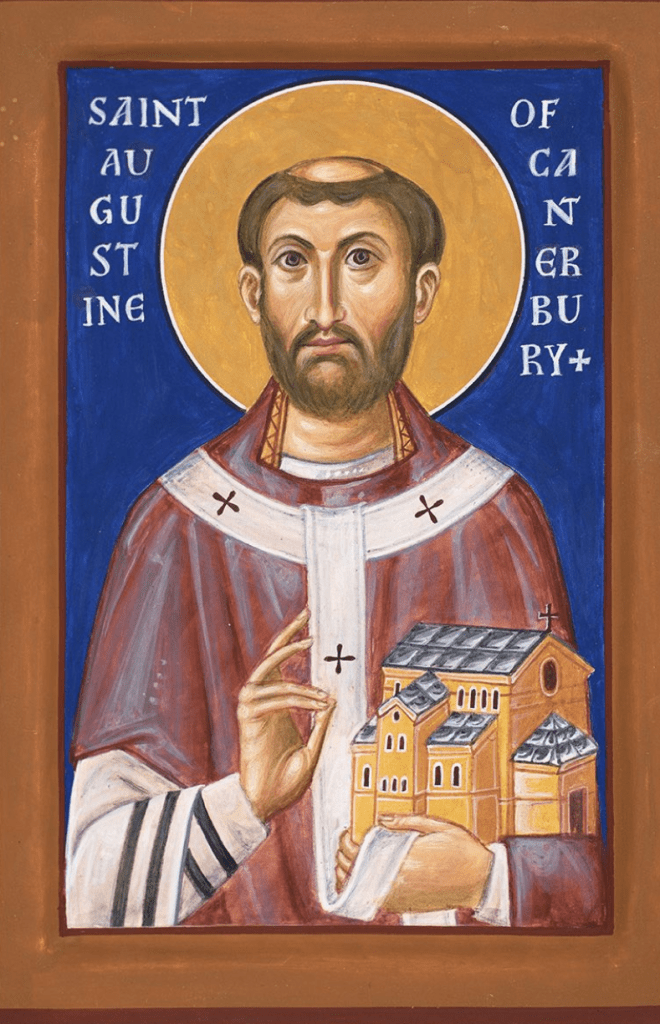
St. Augustine of Canterbury – 27 May

Augustine was the abbot of St. Andrew’s monastery in Rome. Pope Gregory the Great chose him and forty other monks for an important mission. They were to go and preach the Gospel to the people of England. Abbot Augustine and the monks started on their journey. When they reached southern France, people warned them that the English were fierce. The monks felt discouraged. They asked Augustine to go back and obtain the pope’s permission to give up the whole idea. He did, but the pope wanted the monks to go to England just the same. Pope Gregory knew that the people were ready to accept the Christian faith. And so the monks continued their journey. They arrived in England in 597.

The monks were kindly received by King Ethelbert, whose wife was a Christian princess from France. The monks formed a procession when they arrived. They walked along singing psalms. They carried a cross and a picture of our Lord. Many people welcomed the monks’ message. King Ethelbert himself was baptized on Pentecost, 597. That year Abbot Augustine became a bishop.

Augustine often wrote to the pope. And Pope St. Gregory gave him much holy advice. Speaking about the many miracles Augustine worked, the pope said: “You must rejoice with fear and fear with joy for that gift.” He meant that Augustine should be happy that through the miracles the English people were putting faith in the Gospel. But he should be careful not to take credit for the miracles, because they were from God.

At Canterbury, Augustine built a church and a monastery, which became the most important in England. St. Augustine died on May 26, 604, seven years after his arrival in England.
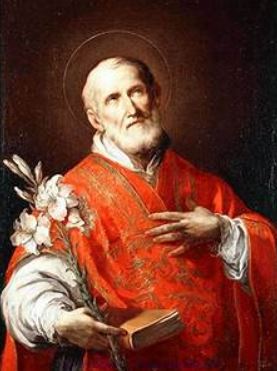
St. Philip Neri – 26 May

st philip Neri

St. Philip Neri was born in Florence, Italy, in 1515. As a child, his nickname was “Good little Phil.” He was always so cheerful and friendly that everyone he met loved him. Philip went to Rome as a teenager. He studied theology and philosophy for three years and was a good student. Above all, Philip was a very active Christian. He lived simply and worked hard. But he also did much good for the people around him. He helped poor children. He donated his time to the sick. He was a friend to people who were troubled and lonely. In fact, he reached out to everybody he could for the love of Jesus.

Philip helped start an organisation of lay people to take care of needy pilgrims. That ministry gradually continued as a famous hospital in Rome. The priest who guided him realised that Philip was doing so much to help the Christians of Rome become fervent again. But it was obvious that Philip had the call to be a priest. He was ordained in 1551, at the age of 36, and quickly became sought after as a confessor. He was available for the sacrament of Reconciliation for several hours every day. The lines of people who came to him grew longer. But Father Philip was never in a hurry. He never ran out of patience and gentleness.

People began to notice that he could read their minds at times. He could also in some circumstances predict the future. The Lord even worked miracles through him. But all Philip wanted to do was bring Jesus to the people. To avoid their admiration, he acted silly once in a while. He wanted people to laugh and forget that they thought he was holy.

Philip was making a difference in Rome. He founded a society of priests called the Oratorians, and the whole city was renewing its faith and devotion. Once he started to think about being a missionary to far–off lands. He was very impressed by the life of St. Francis Xavier, who had died in 1552 at the gate of China. Philip had been a priest for just one year at the time of St. Xavier’s death. Should he leave Rome and volunteer for the missions? A holy Cistercian monk told him, “Rome is to be your mission land.” In fact, Father Philip had become known as “the apostle of Rome.”

Philip spent the last five years of his life offering the Sacrament of Reconciliation to the people. He died at the age of 80 in 1595. He was proclaimed a saint by Pope Gregory XV in 1622.

Cheerfulness is an important part of holiness. St. Philip Neri’s story teaches us that the way to be really happy is to put God and other people first in our lives. If we only think about ourselves we’ll never feel satisfied.

St. Philip Neri pray for us.

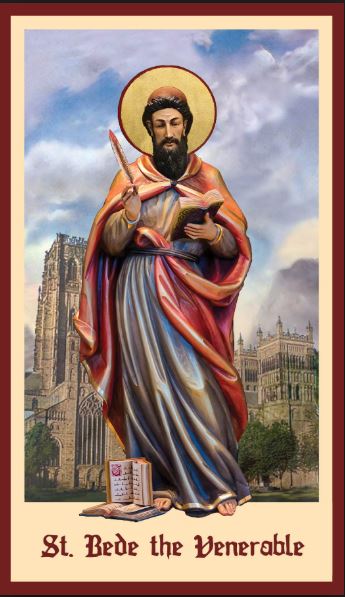
St. Bede the Venerable – 25 May

bede

This saint was famous as a priest, a monk, a teacher and a writer of history. He was born in England around 672. His parents sent Bede to school at the nearby Benedictine monastery. He loved the life of the monks so much that when he grew up he too became a monk. He remained in that same monastery for the rest of his life.

Bede loved the Holy Bible very much. He tells us that it was a joy for him to study the Bible. He loved to teach it and write about it. When he grew older, sickness forced him to stay in bed. His pupils came to study by his bedside. He kept on teaching them and working on his translation of St. John’s Gospel into English. Many people could not read Latin. He wanted them to be able to read the words of Jesus in their own language.

As he grew sicker, Bede realised that he was about to go back to God. He kept on working even when he was seriously ill. At last, the boy who was doing the writing for him said, “There is still one sentence, dear Father, which is not written down.” “Write it quickly,” answered the saint. When the boy said, “It is finished,” the saint said, “Good! You are right—it is finished. Now please hold my head up. I want to sit facing the place where I used to pray. I want to call on my heavenly Father.”

Bede died shortly after, on May 25, 735. He is thought to be the most learned man of his time. His most famous book, Church History of the English People, is the only source for much of early English history. People call Bede by the respectful title of “venerable.” He is also a Doctor of the Church.

St. Bede pray for us.

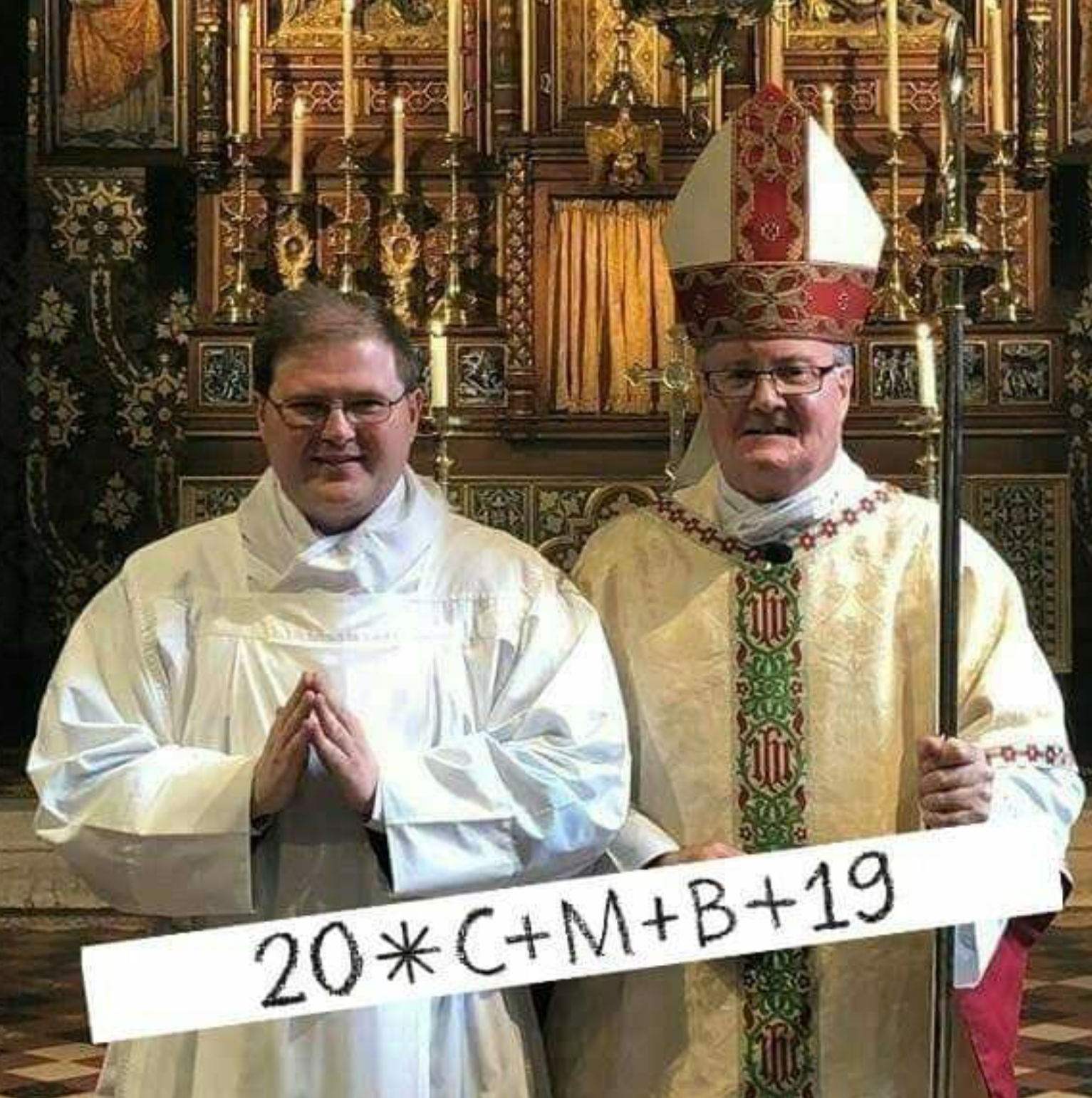
20+C+M+B+19

On or near the feast of the Epiphany, the tradition has been to ask God’s blessing on homes and mark the door post or lintel with chalks that have been blessed for that purpose.
The doors are chalked with the legendary names or initials of the three Magi, and the numerals of the New Year, connected with a series of crosses.
The initials C, M, and B commemorate the Magi, Caspar, Melchior, and Balthasar, but also stand for the Latin prayer-request Christus Mansionem Benedicat: “May Christ bless this house.” In this way, the door of a house would be marked as follows: 20+C+M+B+19

Updated facebook profile picture below. (Taken at the end of my minor ministry mass of Acolyte.)

Saints Michael, Gabriel and Raphael, Archangels – Today’s Feast day

Saints Michael, Gabriel and Raphael, Archangels – Feast: 29th September 2018

St Michael
He is mentioned in the Apocalypse as the leader of the heavenly host. He is a patron of soldiers.

St Gabriel
He appears in the book of Daniel to explain some of the prophet’s visions, and was also the bearer of the Annunciation to the Blessed Virgin Mary.

St Raphael
In the Book of Tobit, he is the angel who heals Tobit of his blindness. His name means God heals.

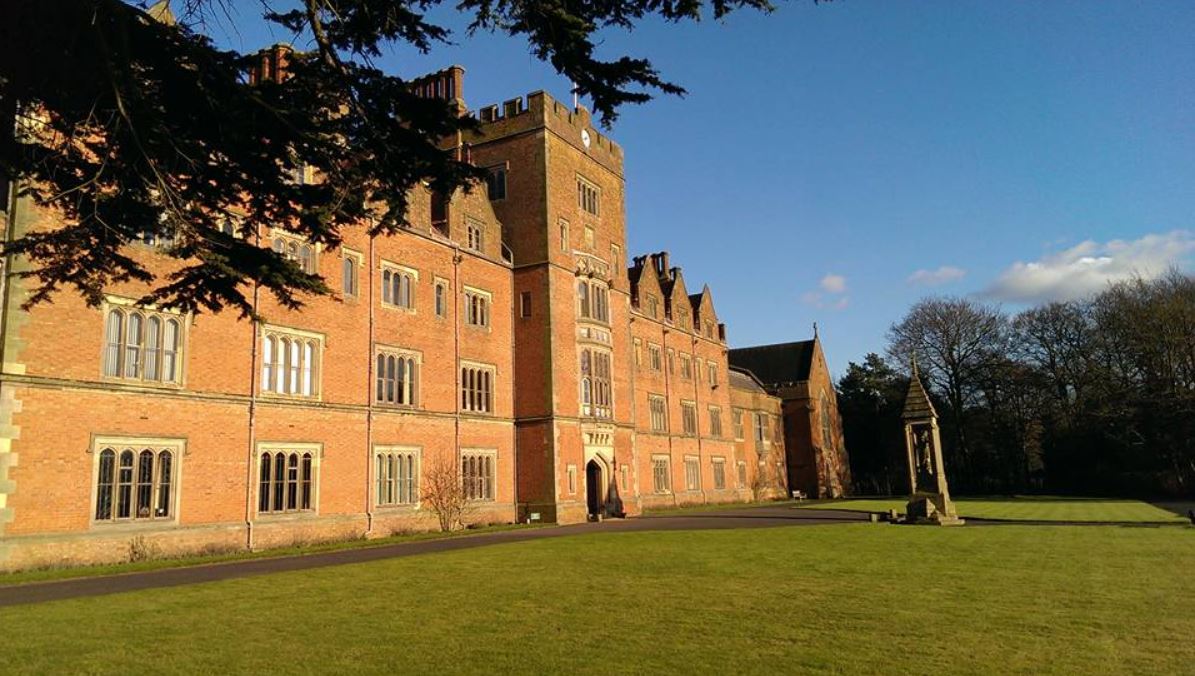
St. Mary’s Seminary College, Oscott return.

oscott1

Start of a new academic year after the summer break. New seminarians, new courses, new house group, couple of new lecturers.

Extra responsibilities this year, I have been elected to be the “year rep” for year 3,  also I am a superuser for the colleges new learning platform called “St. Mary’s interactive learning environment, or SMILE”. Helping seminarians and staff with general troubleshooting over the coming months.

My new courses for this semester are:

Christology, Ecclesiology,  Greek, Moral Theology, N.T John, Sacramentology, and more philosophy.

Going to be a tough year. Had my first Greek lesson today,  I can honestly say it’s all Greek to Me.

Please keep me and my fellow Seminarians in your prayers.

God bless.

lector1


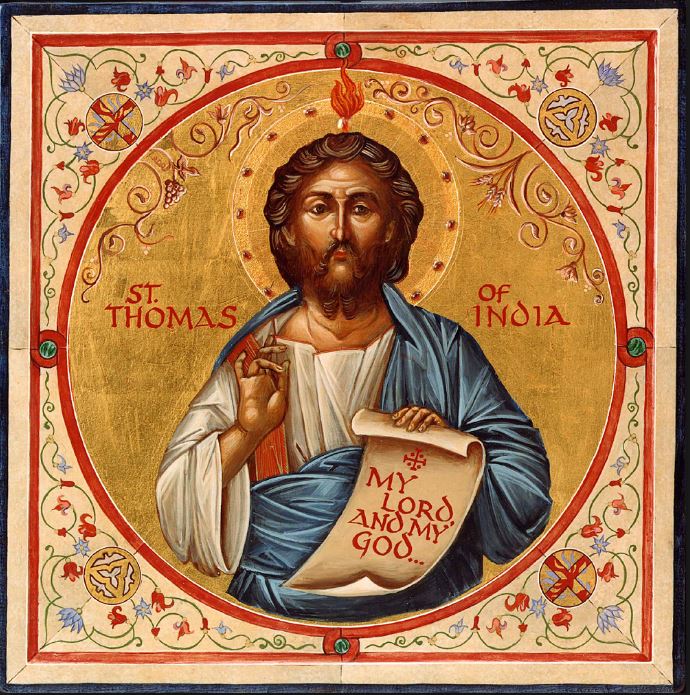
St. Thomas, Apostle – 3rd July

st thomas

Thomas was one of the twelve apostles of Jesus. In the Syriac language his name means “twin.” Once when Jesus was going to face the danger of being killed, the other apostles tried to keep the Master back. St. Thomas said to them, “Let us also go, that we may die with him” (John 11:16).

When Jesus was captured by his enemies, Thomas lost his courage. He ran away with the other apostles. His heart was broken with sorrow at the death of his beloved Lord. Then on Easter Sunday, Jesus appeared to his apostles after he had risen from the dead. He showed them the wounds in his hands and side. Thomas was not with them at the time. As soon as he arrived, the other apostles told him joyfully, “We have seen the Lord.” They thought Thomas would be happy. Instead, he did not believe their message. He hadn’t seen Jesus as they had.

“Unless I see in his hands the print of the nails,” he said, “and put my finger into the nailmarks, and put my hand into his side, I will not believe.” Eight days later, Jesus appeared to his apostles again. This time, Thomas was there, too. Christ called him and told him to touch his hands and the wound in his side. Thomas fell down at the Master’s feet and cried out, “My Lord and my God!” Then Jesus said, “Because you have seen me, Thomas, you have believed. Blessed are they who have not seen, and yet have believed.” You will find this story in the Gospel of John 20: 24–29.

After Pentecost, Thomas was strong and firm in his belief and trust in Jesus. It is said that he went to India to preach the Gospel. He died a martyr there, after proclaiming the Good News of Jesus to many people.

We often hear of St. Thomas referred to as the “doubter.” But the moment he saw the Risen Christ he made an unwavering act of faith. When the priest lifts the sacred Host at Mass, we too can pray the words of St. Thomas, “My Lord and my God!”

St. Thomas pray for us.