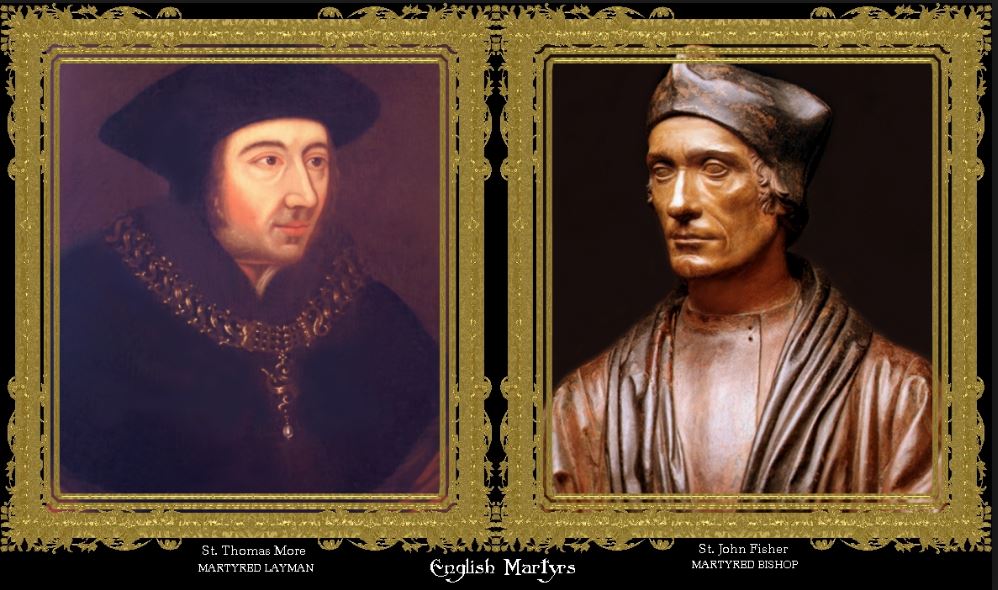
St. John Fisher
John Fisher was born in Yorkshire, England, in 1469. He was educated at Cambridge University and became a priest. Father John taught at Cambridge, too. He was a wonderful teacher and helped the students grow in their knowledge of the Catholic faith. But there was a lot of confusion about religion in those days. Father John helped people to know the truth about God and the Catholic Church.
In 1504, he became the bishop of Rochester, England. It was a poor diocese. Bishop John was to remain its shepherd for thirty years. Besides being the bishop of Rochester, he was the head of Cambridge University. Bishop John also heard the confessions of King Henry VIII’s mother.
Bishop John had many friends, including the famous scholar, Erasmus, and the great Sir Thomas More. Bishop John and Thomas More would have never guessed that one day they would be sharing a feast day on the calendar of saints!
King Henry VIII became angry with Bishop John for insisting that his marriage to Queen Catherine was true. Then Henry VIII divorced Catherine and married Anne Boleyn in a civil ceremony. The king demanded that people sign an oath of loyalty to him. He made himself head of the Church in England. Bishop John would not sign the oath. He was arrested in 1534 and sent to the Tower of London. The tower was damp and the treatment was harsh. Bishop John suffered very much, but he would not betray his faith. Even though there were no televisions and radios back then, people found out about what Bishop John, Sir Thomas More and others like them were going through. They were shocked and saddened. On 12th June 1535, Pope Paul III named Bishop John a cardinal. He hoped this would make King Henry set him free. But the king only became more angry and mean. After ten months in prison, Cardinal John was beheaded on 22nd June 1535.
Along with his friend, Sir Thomas More, Cardinal John Fisher was proclaimed a saint by Pope Pius XI in 1935.
Sometimes it’s much easier to go along with the crowd rather than stand up for the truth. But the story of St. John shows that God will always give us the strength we need to do the right thing.
St. John Fisher pray for us.
St. Thomas More
Sir Thomas More was a famous lawyer and writer. He was born in London in 1478. His father had been a lawyer, too, and a judge. Thomas was always grateful to his father for being so loving and for not spoiling him.
Thomas’ first wife, Jane Colt, died when she was very young. Thomas was left with four small children. He got married again to a widow named Alice Middleton. She was a good but simple woman who could not even read or write, even though Thomas tried to teach her. Thomas made home life enjoyable for his family because he was so pleasant to be with. During meals, one of the children would read from the Bible. Then they would have fun and tell jokes. Thomas often invited poorer neighbours to come to dinner, too. He always helped the poor as much as he could. He loved to delight his guests with surprises. He even kept some playful monkeys as pets. But few people could have imagined how deeply religious Thomas really was. He prayed long hours into the night and performed penances, too. He was very much aware that he needed the grace and help of God to live as a true Christian.
Thomas held important government positions in England. For three years he was Lord Chancellor, another name for prime minister. King Henry VIII used to put his arm around Thomas’ shoulder because they were such good friends. Although Thomas was most loyal to the king, he was loyal to God first of all. In fact, when the king tried to make him disobey God’s law, Thomas refused. King Henry wanted to divorce his wife and marry another woman. However, the pope could not give permission, since that is against God’s law. Henry was stubborn and at last he left the Church. He wanted everyone to recognize him as the head of the Church in England. Thomas could not do that. He chose to remain faithful to the Catholic faith and to God. He was condemned to death for that, yet he forgave his judges. Thomas even said that he hoped he would see them in heaven. He really meant it, too.
At the scaffold, where he was to die, Thomas declared himself “the king’s good servant, but God’s first.” He kissed his executioner on the cheek. Then he joked, saying that his beard should not be cut off because it had not done anything wrong. Sir Thomas More was martyred on Tuesday, 6th July 1535, at the age of 57. Sir Thomas More was proclaimed a saint by Pope Pius XI in 1935, together with his friend, Bishop John Fisher. He is the patron saint of lawyers.
St. Thomas risked losing everything: his fortune, his position, his own security and even the safety of his family. But he held fast to his Catholic faith, even to the point of sacrificing his life. Like his friend St. John, Thomas was able to remain strong because he prayed and trusted in God. Let’s try to be like him.
St. Thomas More pray for us.




 Rev. Fr Philip Wrigley's Blog